After Summer School Rotterdam

After Summer School returns from 18 to 21 September 2025 with four days of city classes scattered across Rotterdam. Studio Makkink & Bey & WaterSchool curated and composed two classes 'The Silver Diplomat'.
Water is 'The Silver Diplomat'
Water can act as a connector, communicator, and a diplomat in times of fragmentation, migration, and geopolitical tension. WaterSchool explores the spaces where non-human species are reclaiming territory. In these transitional zones, we use Live Action Role Playing (LARP) as an experiential participatory method to investigate ecology and social structures.
Stories, rituals, and objects encourage new behaviours and understanding. In doing so, a living landscape takes shape, one where learning, behaviour, and transformation can occur. This embodied approach invites participants to become part of a regenerative ecosystem that is constantly evolving.
LARP the Silver Diplomat by Mathilde Patuelli & Roberta di Cosmo, Chester Chuang in collaboration with Studio Makkink & Bey and WaterSchool. WaterSchool asked Di Fang and Anastasia Eggers to further develop their research into respectively invasive species and river fisheries in the Nieuwe Maas/ Nieuwe Waterweg region, extending to the North Sea. The movie 'Invisible Arrivals' by Di Fang and the sound installation 'Echoes of the Nets by Anastasia Eggers are also part of The Silver Diplomat program.
This After Summer School class, partly developed for and made possible by Bauhaus of the Seas, takes place on
Saturday 20 September, 15:30 – 18:30h and
Sunday 21 September, 11:00 – 14:00h
Marconistraat 85, Rotterdam
Ticket only € 5 for all classes.
book your ticket
image by Timothy Liu
Polder triënnale 2025 - workshop day October 4

Every three years, the polder triennale transforms Flevoland’s Noordoostpolder into a hub for experimentation, collaboration, and innovation. This year’s theme, "learning production landscape," explores how we can combine learning, making, and producing to create sustainable solutions for food and construction. We invite students, farmers, artisans, designers, neighbours, researchers and all people interested to join us at our farm in Kraggenburg for a workshop day.
What to expect
* hands-on workshops with natural materials: clay, flax, reed, and wood.
* learn from experts like Atelier NL (clay), Aliki van der Kruijs (flax), Klaas ten Napel (reed), and Jacob Oomen (wood).
* exchange knowledge and contribute to regenerative solutions that turn local materials into globally relevant innovations.
Program
09:30am
opening with Vera Dam (director, Natuur- en Milieufederatie Flevoland) and inspiring talks
11:30am — 04:00pm
workshops—discover material properties, tools, and techniques
04:00pm
wrap-up and evaluation
Location
Cultural farm Studio Makkink & Bey, Kraggenburg, Flevoland
More information
This is your chance to learn by doing, connect with like-minded creators, and help build a resilient ecosystem. Tickets only € 50 (including lunch, coffee, tea, and water). Limited spaces!
book your ticket
Interior design The Park Pavilion Rotterdam

The Park Pavilion is the new home of Foundation The Park (established in 2022). The foundation has the goal to maintain the park, which is the largest green national monument in Rotterdam. The pavilion, a former convalescent home, also offers an in-depth program at the intersection of art and nature with the park as a source of inspiration: from exhibitions and poetry to music and walks.
From 1852 onwards, the park was designed by landscape architects father and son Zocher as a romantic walking area. The pavilion was neglected for many years, but now serves as the host of the place. It is not an economic place or café, but rather a sanctuary for human health. A place to come to, without having to consume. An open place for people, culture, park, nature, health. You are welcome to come as often as you like, and if you come more often, feel free to occasionally pick up the broom.
The pavilion also houses the gardeners' workshop and public spaces. The interior design by Studio Makkink & Bey retains the historical elements from the original state of the building. Light, air, and spaciousness of the convalescent home and the direct connection with the park have been restored.
The renovation started in the third quarter of 2024, the pavilion opened mid-June 2025. The appearance of the pavilion is a three-dimensional translation of what the foundation represents. The colours and scents are like those of nature: fresh, woody, and warm. The interior is made of natural, sustainable, honest materials and was locally produced. The raw materials are of recognizable origin; the furniture, designed and curated by Studio Makkink & Bey, is made of trees from the park. The look is natural, robust, and refined. Design by Michou Nanon-de Bruijn.
More images
WaterSpiegelingen (WaterReflections) in Cuypershuis Roermond

15.06.2024 - 05.01.2025
Tuesday to Sunday 11 - 17.00h
Cuypershuis Roermond
Impession exhibition
The Cuypershuis showcases the life and work of architect Pierre Cuypers in his former home and workshops. The work of his son Joseph is also featured. By placing their ideas from different perspectives and disciplines in a contemporary context, we discover again and again that they were well ahead of their time. The WaterReflections exhibition brings together Cuypers’ vision and the WaterSchool design-research project by Studio Makkink & Bey to tell a story about the design of our living environment.
In the exhibition, you will see collages and imaginary landscapes showing what the city would look like if we designed it with our water footprint in mind. You will discover objects by contemporary artists and designers that show how using new bio-based materials and small-scale local production lead to other forms of architecture, urban development and a new way of living together. The chosen examples invite wonder while telling stories about the world, its history and potential future. Together they represent a sustainable, circular and regenerative movement to address today’s environmental and social challenges.
Venue
WaterSpiegelingen
WaterSchool Library of bodily Fluids Ornamenta

Ornamenta is a regional exhibition for contemporary art and design, held every five years in Pforzheim and various Black Forest communities. Visitors are invited to explore exhibition routes that uncover the region and showcasing new collaborations between artists, designers, regional businesses, community organisations and local cultural institutions.
WaterSchool is part of the 'Bad Databrunn' theme. For centuries, Germany has embraced the concept of 'Kür' (Spa), a holistic approach to healing that emphasizes spending time in nature, utilising thermal waters.
The exhibition builds on this tradition. In a former spa, WaterSchool shows her 'Library of bodily fluids'. Starting point is a research by future medical documentation specialists and librarians at BFW Bad Wildbad, a vocational training center and rehabilitation institution. The 70 silver spoons hold approximately the amount of liquid that has collected in an adult's bladder when the urge to urinate becomes noticeable, created by students of the Pforzheim Goldsmith and Watchmaking School. Visitors of the exhibition “Bad Databrunn” are invited to drink the regional mineral water while browsing the Library of bodily fluids.
Until September, 29 | Friday to Sunday, 10:00 — 20:00h
Forum König-Karls-Bad | König-Karl-Straße, 175323 Bad Wildbad
More information
photo by Sander van Wettum
New ecosystems at Museum De Fundatie

Every year, Proto, together with Museum de Fundatie, invites two artists-in-residence, who work on an exhibition together with the students. This year, designer Jurgen Bey and creative chef Jasper Udink ten Cate were guests at Proto. Bey and Udink ten Cate investigated how to create a new, self-contained ecosystem using different ingredients, especially in such a historic place. Together with the students, they thought about what you need for this. The result was shown from 26 to 30 June 2024 in the garden of Het Nijenhuis Castle in Heino, the outdoor location of Museum de Fundatie.
The less temporary part of the exhibition is in the Garden Room of Castle Nijenhuis and visible until November 3. Expect unique pieces from the history of the studio, still relevant today.
Untill November, 3 | Tuesday to Sunday, 11:00 — 17:00h
Kasteel Het Nijenhuis — Heino/Wijhe (NL)
image by Martijn Schmidt
Wasserschule, Eine Spekulation in vier Jahreszeiten

26.05.- 13.10.2024
Schloss Hubertusburg, Wermsdorf, Deutschland
https://designcampus.org/
WATERSCHOOL, Exhibition
A Speculation in Four Seasons
Check out more images
A project of the Kunstgewerbemuseum / DESIGN CAMPUS, Staatliche Kunstsammlungen Dresden in collaboration with Studio Makkink & Bey, Rotterdam (NL), and the municipality of Wermsdorf.
The WaterSchool is a speculative framework that proposes to rethink the cultural, didactic, and infrastructural model of education and living, relating all these facets to one theme: water and its interconnections. The food we eat, the clothes we wear, and the houses we live in affect our direct and indirect use of water. What will the urban and rural landscape look like if we consider, for example, the production and development of sustainable housing, bio-based materials, green industries, renewable energy sources, new types of food, and equitable interaction between all organisms? The WaterSchool imagines an approach to resources that is rooted in inclusivity over exclusivity, fostering a new concept of luxury centred on sustainability rather than exploitation.
In this exhibition, Schloss Hubertusburg – a place where a peace treaty was signed in 1763 – once again becomes a venue where the peaceful future of resources is negotiated. Looking back at the historical context of the centuries-long struggle for resources and the power structures built around them, we urgently need to rethink their use, ownership, and accessibility. The building itself as a spatial resource has seen many uses – as a royal hunting lodge, a military depot, a manufactory for stoneware and other goods, a prison, a hospital, and a psychiatric clinic: so why not as an educational facility?
The WaterSchool imagines Schloss Hubertusburg as a place of learning and forming connections with the productive landscapes around it – in the fields of agriculture, forestry, aquaculture, and domestic economy. In this exhibition, the speculative future of Hubertusburg and its surroundings is deconstructed into four seasons, each addressing a speculative landscape of living and working through objects, paintings, and drawings. The framework proposed by the WaterSchool is brought to life in this exhibition accompanied by historical and contemporary pieces from the Staatliche Kunstsammlungen Dresden, the DESIGN CAMPUS Summer School, and through the exhibits of artists, designers, architects, and local partners, whose work promotes interaction between all organisms, communities, and their environment.
image Tom Dachs
Opening Interior design IMMA Matheson Creativity Hub
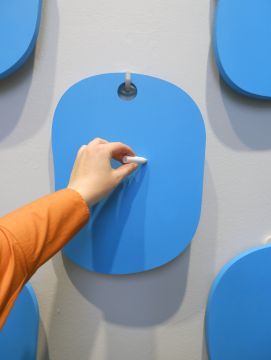
The Irish Museum of Modern Art, IMMA in partnership with Matheson commissioned the design for the 'Matheson Creativity Hub' in memory of Tim Scanlon
The Matheson Creativity Hub will be a prominent space that is activated by IMMA’s Engagement & Learning Department, Visitor Engagement Team, community groups, creative partners, and artists, as well as a space for audiences to dwell and explore on their own. It will be an innovative reimagining of convivial space that invites exceptional architecture and design to provide a welcoming and inclusive environment that allows for experimentation, supports creative engagement, and social connectivity for audiences of all ages.
The design of the IMMA Matheson Creativity Hub provides endless possibilities to host diverse activities for an inclusive community. It acts as a place to inspire and be inspired by while providing attributes to activate participation around modern art and artistic expression. Here, visitors indulge in experiencing the embodiment of diverse artistic practices. With and without programming, the space offers a soft invitation to participate.
WaterSchool's Cabinet of Curiosities at Porto Design Biennale
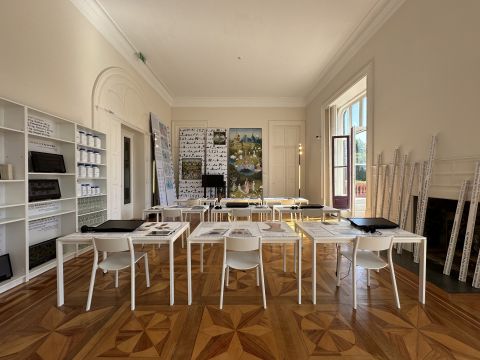
WaterSchool is part of the core programm at the Porto Design Biennale, initiated by esad—idea, the Research and Development (R&D) unit of ESAD – School of Arts and Design. The theme is ‘Being water: how we flow together and shape each other’, curated by Fernando Brízio.
WaterSchool transformed the Biodiversity Gallery into a Cabinet of Curiosities, exhibiting a wide variety of works by invited artists, architects and designers. The exhibition serves as a conversation starter in order to instigate discussions on how dwelling, living and working could be rethought and even redesigned bearing water and its impact in mind.
From October 19 to December 3, 2023.
WaterSchool exhibition @ Galeria da Biodiversidade — Centro Ciência Viva / MHNC-UP
Rua do Campo Alegre, 1191, 4150-181 Porto
Tuesday to Sunday
10:00 — 13:00h, 14:00 — 18:00h
Last admission: 17:30h
More information on WaterSchool presentation in Porto
More information on Porto Design Biennale
image by Pichaya Puapoomcharoen
4-Day WaterSchool workshop in South Korea
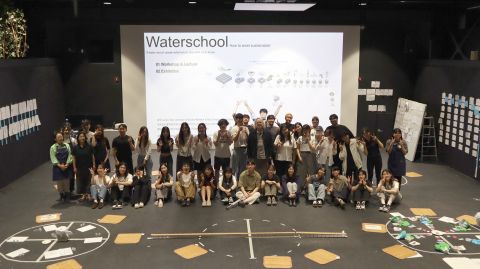
Spanning four days from July 11th to the 14th of July 2023, and involving 36 design students from 8 universities, this workshop was designed to foster an understanding of water to be liked and wished to be taken care of.
Each participant group delved into the hidden aspect of water, including water footprints, reimagining dining experiences with reduced water usage by examining the dishes and their accompanying objects through this lens. Each group worked on proposing one object and one meal, using A4 paper for research, graphics and prototyping the object.
The results will be shown in a video presentation and exhibited at the Cheongju Craft Biennale 2023 at the Cheongju Cultural Center (South Korea) from September 1st to October 15th.
Composing a Tree trunk bench for Cheongju Craft Biennale 2023
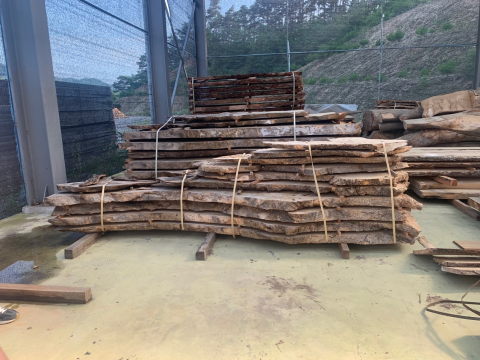
Jurgen Bey's Tree trunk bench will be exhibited during the Cheongju Craft Biennale 2023 at the Cheongju Cultural Center (South Korea) from September 1st to October 15th.
The Tree trunk bench consists of 3 bronze casts of chair backs only. A fallen or felled tree must be found locally. The casts transform the trunk into a piece of furniture.
When visiting Cheongju for WaterSchool Jurgen Bey was invited to visit the logging company to choose the felled tree to serve as the giant bench. The tree trunk bench will arise as the the bronze chair backs are connected to the log.
Cheongju Craft Biennale
WaterSchool at Ornamenta in Bad Wildbad (Black forest, Germany)

WaterSchool was part of the prologue exhibitions and events throughout the Northern Black Forest Region (Germany) for Ornamenta 2024.
The one day group show titled Bad Databrunn, presented three different perspectives for a post-burnout society. Visitors were welcomed in a historic bath house in the spa town Bad Wildbad to discover new ways of dealing with physical and virtual stress by learning to deal with water flows and data streams.
To start up a new educational and research platform, we met with Bad Wildbad's Vocational Training Center and Silver & Goldsmith Schulz Pforzheim to discuss a new curriculum for future ways of living with water. We brought our project GLASS-works Matter: a set of drinking glasses with a total volume of 70 litres, the amount of water in a human body. The glasses are collected from the stocks in recycling shop Circulair Warenhuis, engraved with delicate drawings of body organs and placed on an embroidered table cloth, also made in the workshop of Circulair Warenhuis. Visitors could watch how the glasses were graved with the drawings during the day.
Venue
Studio Makkink & Bey wins design competition IMMA
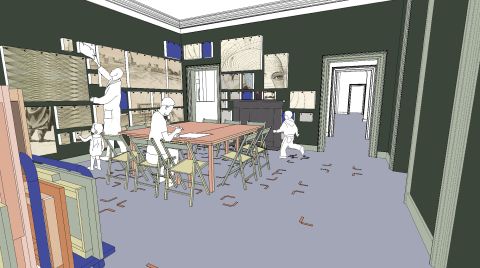
IMMA, the Irish museum of modern art in Dublin, in partnership with law firm Matheson LLP invited artists and designers to apply for the design competition for the 'Matheson Creativity Hub’. We are super happy to be the winning practice to design this new community space.
The project consists of three intersecting rooms, accessible both from the main reception of the Museum and open out into the courtyard. The relationship between the outdoors and the galleries is a key point of interest. The interior will have flexible design elements which can be easily moved between the Hub and the courtyard, and possibly other locations around the site. The implementation will run throughout 2023 and early 2024.
WaterSchool at Het Nieuwe Instituut
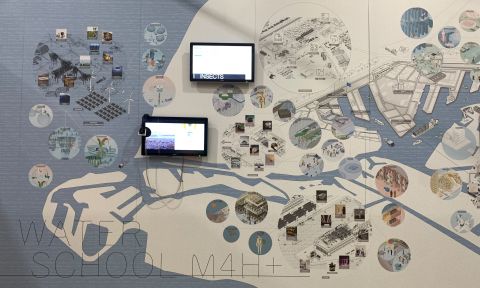
Rotterdam Architecture Month is the Netherlands’ largest architecture festival about the future of the city organizing and facilitating over 125 activities across 40 locations. This year’s theme for RA Month in June is Liquid City.
The Water Cities Rotterdam exhibition at Het Nieuwe Instituut will have floating pavilions on the ponds of the Museumpark by architect Kunlé Adeyemi. The accompanying exhibition features a selection from the National Collection for Architecture and Urban Planning and, amongst others, work by Studio Makkink & Bey & WaterSchool.
From May 14 to October 22.
More information & tickets
Cabinet of curiosities

The KNAW, the Akademie van Kunsten in cooperation with Studio Makkink & Bey & WaterSchool opened an exhibition dedicated to water in all its facets. Until July 2023 this exhibition will function as the setting for a series of roundtable discussions with artists, scientists and designers. On selected days the exhibition will be open for guided visits.
More information
30 years Droog
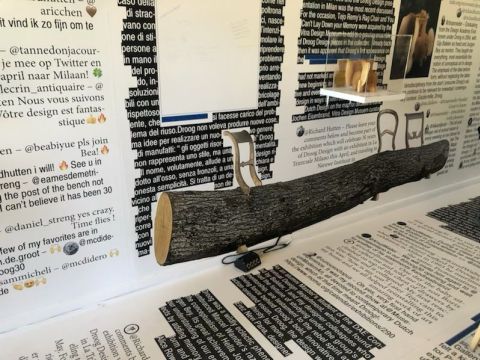
2023 marks the 30st anniversary of Droog - it was 1993 when a group of young Dutch designers gathered under the name Droog broke into the FuoriSalone in Milan.
In the exhibition ‘Droog30 – Design or non-design?’ the designs are placed in a spatial translation of a social media feed. With this, curators Maria Cristina Didero and Richard Hutten, make the Droog mentality both tangible and comprehensible – ever unafraid of strong reactions and still swimming against the current. The installation shows a.o. Kokon and Tree Trunk Bench of Jurgen Bey. Last April on show at the Triennale Milano, it has now travelled to Het Nieuwe Instituut in Rotterdam.
Tickets
Video portrait Dutch Design Award 2022
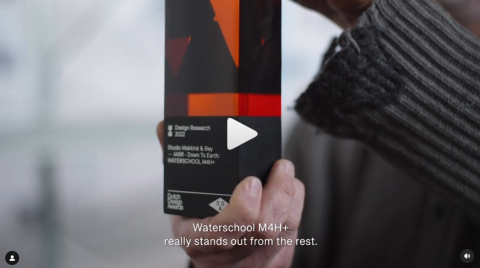
DDA made a video portrait of WaterSchool M4H+, commissioned by IABR (International Architecture Biennale Rotterdam) celebrating the Dutch Design Award 2022 in the category Design Research.
Check it out
Celebration WaterSchool
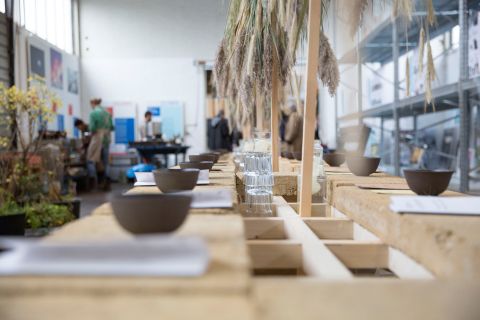
Last december we celebrated the Dutch Design Award for WaterSchool by inviting Suzanne Bernhardt and Philipp Kolmann to share their project 'Ears of Earth' with us. In 8 courses and in a special setting in the WaterSchool they took us along to the flavours of the earth. With ancient grasses and traditional fermentation techniques from different parts of the world we went back to the basics of our food.
A beautiful afternoon and evening with WaterSchool partners and designers, sharing ideas, meanwhile marking our 20th anniversary.
Photo by Timothy Liu
WaterSchool wins Dutch Design Award
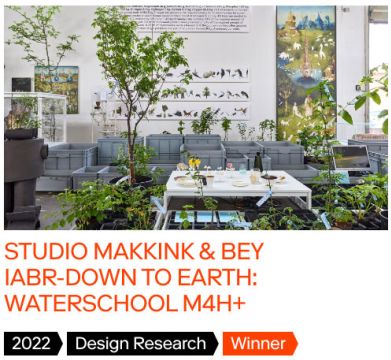
WaterSchool has won the Dutch Design Award 2022 in the category Design Research.
The jury report: "WaterSchool M4H+ is a research project that absolutely excels: a textbook example of how design research can play an educational role. Studio Makkink & Bey shows how, with a large group of designers and thinkers, you can analyse, understand, and experience an urgent theme like water use in all kinds of ways. Makkink & Bey are always and everywhere generous in sharing their knowledge and self-learning capabilities. This studio has been operating at the forefront of research by design for years and, with Waterschool M4H+, addresses a relevant topic in an open and exemplary way, which also has a substantial effect due to its longevity."
"WATERSCHOOL M4H+ is a convincing project that tackles an extremely urgent and complex subject. Studio Makkink & Bey is involved in every aspect of the design and knows how to involve the right partners as well as a large number of young makers. WATERSCHOOL M4H+ gives shape to the principle of ‘learning by doing’. Studio Makkink & Bey takes on a whole range of roles; from planner, architect and designer to curator, mediator and moderator. The result is a clear set-up, multifaceted and well-presented research, and a wide scope for this comprehensive project that hits home on all levels."
Dutch Design Awards page
website WaterSchool
website IABR WaterSchool
Thank you to all designers, architects and artists who collaborated with us!
Polder Triennial 2022
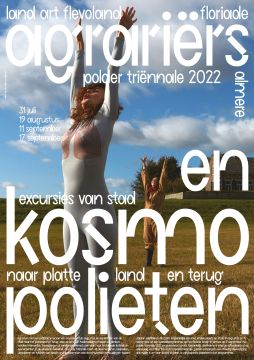
The aim of Polder Triennial is to show, discuss, try out and initiate ideas and meetings about the shifting relationships between city and countryside. In this first edition, join a program of four excursions throughout July, August and September, that travel from city to countryside and back. Polder Triennial is an initiative of Rianne Makkink, cultural strategist Willem Schenk and curator Jules van den Langenberg.
Tickets for the first tour Island hoppers on July 31 are now available
The program is from 1pm to 6.30pm and consists of visits to landscape art work riff and Unesco world heritage Schokland, workshop by movement artist Natasha Papadopoulou, cabaret show 'De blauwe vinkjes' and presentations by theater group Gouden haas, researcher Adriaan Duiveman and Land art Flevoland along the way.
Other tour dates are (all different visits and artists): August 19, September 11 and September 17. All tours are free of charge, participation upon request via this link. You will receive an acknowledgment of receipt required to board the tour. Starting point of all tours is Floriade entrance in Almere.
More information
Water Biennial Utrecht 2022
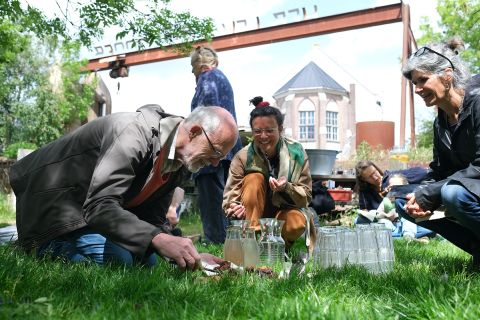
Water Biennial Utrecht is a cultural and scientific programme, stage and platform about the wonderful history and world of water. Our particular attention goes to an innovative and learning program for children. Water Biennial is initiated by Metaal Kathedraal Utrecht and curated by Metaal Kathedraal, Studio Makkink & Bey & WaterSchool and Fluid Future. It is developed on behalf of the province of Utrecht.
In July, August and September, you (and your (grand) children) can join our WaterExpeditions. Packed for a real expedition, we'll head out and research water under the guidance of various experts: what is it, what is its quality and what role does water play in our lives? The first expedition with Li An Phoa of Drinkable Rivers (photo above) has already given us valuable initial data to include in the WaterArchive that the Water Biennial is building physically.
The next expedition WonderWater is Saturday, August 27, with experts Frank Collaris and Lilly Huis in 't Veld of BlueEarth Innovations. The 3rd expedition Wijwater with experts Frank Silvis and Claudia Jansen is September 25. The presentation of all research results ánd opening of the WaterArchive will be on October 1.
Get your tickets
photo by Rens Spanjaard
Design & Dynasty Fulda (DE)
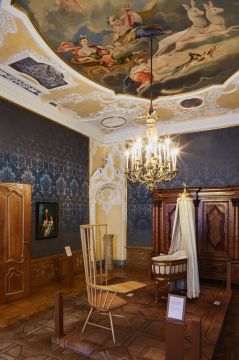
In the exhibition Design & Dynasty - royal art and Dutch Design, historical objects are shown next to handcrafted furniture, couture, accessories, jewellery and photography of contemporary artists, designers and photographers.
We are happy that our Rotterdam Chair is included in one of the rooms in the baroque palace. Curated by Nicole Uniquole, art direction in cooperation with Maarten Spruyt.
photo by Nicole Marnati
More information
WATERSCHOOL - Garden of Delight in Milan
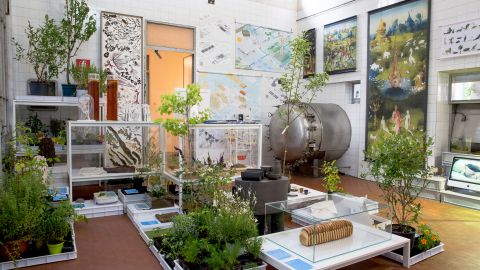
WATERSCHOOL unites over 25 designers, architects and artists in an experimental Garden of Delight. WATERSCHOOL exhibits site-based research on how to sustainably (re)develop harbour cities.
Through showcasing over 25 designers, architects and artists, the Garden of Delight contributes to a sustainable, circular and regenerative learning environment in order to meet our looming ecological challenges. WATERSCHOOL exhibited at Milan Design Week and Fuorisalone at Alcova from June 5-12, 2022.
WATERSCHOOL’s goal is to raise awareness of our huge water footprint. Water use becomes a leverage point for a collaborative exploration of a learning-by-doing approach to the production landscape. Living and working blend, all while being designed around the prospective use of water and our resources. WATERSCHOOL operates as a test site and as an experimental catalyst for sustainable area (re)development, meanwhile gathering and distributing knowledge.
photo by Timothy Liu
WATERSCHOOL to Design Fest Ghent
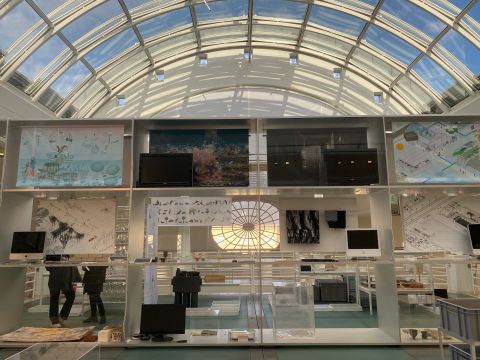
WaterSchool will be part of Design Fest Ghent from 22nd of April untill 1st of May. Design Fest Gent is a new biennial 10 day festival that offers designers space to present their ideas. By focusing on sustainability in all its facets, Design Fest not only wants to inspire the visitors and residents of Ghent but also challenge them and encourage dialogue.
Design Fest Gent demonstrates what design can (and indeed should) be: inquisitive, experimental and activistic. The aim of Design Fest is not merely to present things but also to focus on creation, experience, meeting, stimulation and amazement. An extensive range of installations, workshops and lectures are bundled in three content clusters: Look Back, Move Forward and Do Care. Look Back shows projects bringing together craft, tradition and new technology. Move forward focuses on hybrid collaborations between science, design and technology with nature as a blueprint. Do Care gathers designs with a social impact.
Check out the Design Fest Ghent website
Get your tickets
WaterSchool to World Expo Dubai

The Dutch Pavilion at the World Expo Dubai will present an installation of WaterSchool from 5th to 19th of March 2022. The installation is the result of a research by Studio Makkink & Bey within the framework of the WaterSchool, a self-initiated design research looking into the possibilities of founding a school revolving around water, expressing this in its architecture, interior and curriculum.
The installation consists of a frame of a 20 feet shipping container, a volume that is equal to the volume of water an average Dutch citizen consumes directly per year (43.435 liters). One also consumes water indirectly through the water it takes to produce objects and services we interact with on a daily basis, like clothing, transport, growing crops. This is also represented in the installation by showing smaller volumes and objects from selected designers located inside the larger volume, forming a miniature learning environment at the same time.
Designing Expo Gouda Makes

From 6 April to September 2022, the exhibition 'Expo Gouda Makes' offers an inspiring platform for stories, conversations and connections between young and old about the ever-changing work in Gouda. The exhibition is designed by Studio Makkink & Bey.
The exhibition is a gift of the volunteers of GOUDasfalt to the residents of Gouda for the celebration of 750 years of Gouda. Expo Gouda Makes brings visitors along various branches of the Gouda industry, past, present and later. Six important Gouda industry groups are highlighted: Oils & Fats, Ceramics, Textiles & Yarns, Transport, Foodstuffs and Construction & Machinery. The exhibition can be seen in the Viruly Soap Factory on the Croda site, the former candle factory.
website Expo Gouda Makes
Polder TV
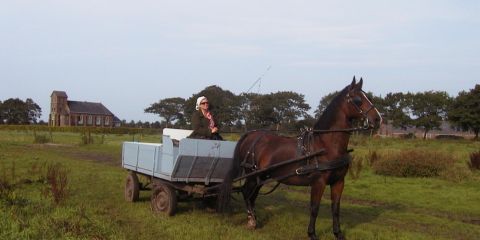
Polder TV marks the beginning of the Polder Triennal, a new initiative that shows, discusses, and unpacks ideas about the changing relationships between cities and the countryside.
The Polder Triennal and Polder TV are initiatives by strategist Willem Schenk, curator Jules van den Langenberg and architect & designer Rianne Makkink. Polder Triennal will take place in the summer of 2022. From this year on they will organize a landscape triennial every three years to show the heritage and new potential of existing places in the Noordoostpolder.
Watch season 1 - 6 episodes
Watch season 2 - 6 episodes
WaterTalk
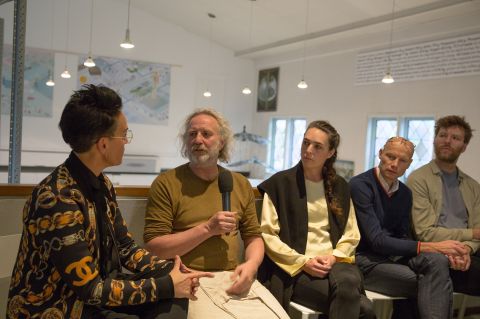
During the WaterSchool exhibition at Dutch Design Week, the new general and artistic director of the International Architecture Biennale Rotterdam IABR, Saskia van Stein, moderated the WaterTalk.
We explored what urban development, the design of our living and working environment and the local production of food and energy can look like if you link it to the water challenge - too much, too little, too dirty - and our water footprint. With Henk Ovink - water envoy of the Netherlands, Jurgen Bey - Studio Makkink & Bey, Mark IJzerman - audio visual designer, Maartje Dros - Studio Klarenbeek & Dros, Eliza Scholtens & Emma Raijmakers - Flip the City.
Watch the WaterTalk here
Dutch Design Award Best Commissioning for Circulair Warenhuis
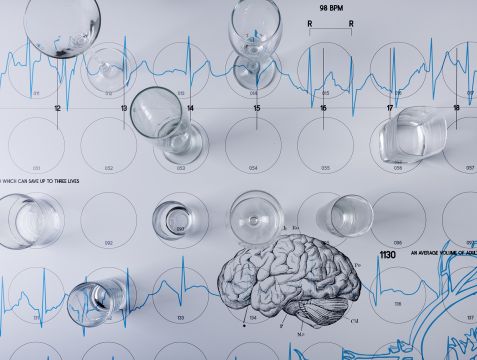
The Dutch Design Award for Best Commissioning 2021 was won by Circulair Warenhuis. Congratulations!
The Warenhuis is one of the largest recycling companies in the Netherlands. About thirty percent of their annual collection of three million kilos of goods turns out to be unsaleable. Together with Popma ter Steege Architects, buro bordo and Raw Color, the Warenhuis is looking for new ways of reuse and awareness. Designers Nienke Hoogvliet, Max Lipsey, Studio Makkink & Bey and Fraser McPhee have each investigated a residual flow and developed a prototype that is produced in the workshops of Het Circulair Warenhuis.
Studio Makkink & Bey researched the glass stocks and developped the GLASS-works Matter series: a set of drinking glasses with a total volume of 70 litres, the amount of water in Jurgen Bey’s body. The glasses are collected from the stocks in the shop and engraved with delicate drawings of body organs. There is also an embroidered table cloth, also made in the workshop of Circulair Warenhuis, matching the collection and to be sold along with the glass set.
image by Cassander Eeftinck Schattenkerk
WaterSchool Dutch Design Week 2021
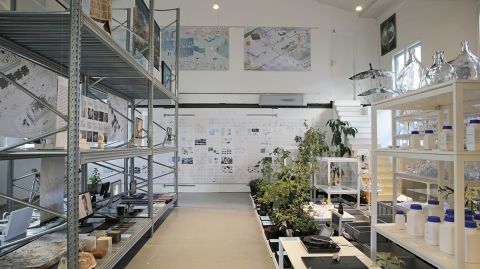
The WaterSchool exhibition IABR—DOWN TO EARTH: M4H+ travelled to the Dutch Design Week in Eindhoven, from 18 until October 24, 2021. The Dutch tv broadcaster VPRO has chosen the WaterSchool exhibition in their 10 tips for Dutch Design Week list!
WaterSchool was visible on two locations:
the IABR–DOWN TO EARTH: WATERSCHOOL M4H+ exhibition landed in the beautiful building of Atelier NL, the installation INDIRECT INVISIBLE WATER, made by Studio Makkink & Bey, Studio Corvers and Carla Herrewijnen for WaterSchool was visible at the Embassy of Water.
Next to the exhibitions WaterSchool hosted a rich programm of talks and get-togethers.
image by Timothy Liu
9th June - 30 July | IABR—DOWN TO EARTH: WATERSCHOOL M4H+
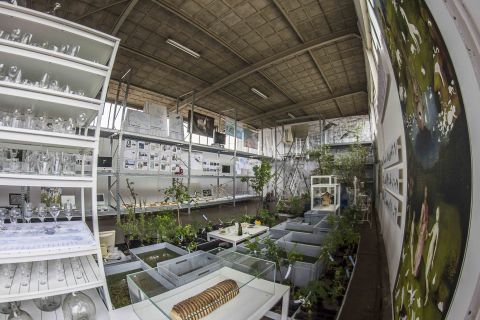
WATERSCHOOL M4H+ investigates how a range of resources can contribute to building a sustainable and circular learning environment, in order to meet the water challenge and ensure an optimized ecological footprint for the 6,300 future residents of Merwe-Vierhavens M4H+.
It illustrates what this new living and working environment could look like when its development is guided by a resource use that allows for the just interaction between all organisms, communities, and their environment.
The exhibition shows work of over 30 selected designers, architects and artists and a Waterschool (digital) library addressing the themes and collecting the results of the research by design into those resources that can serve as (building) materials and/or food while having a responsible relationship to water use.
WATERSCHOOL M4H+ @ Studio Makkink & Bey
Marconistraat 85, Rotterdam
9 June - 30 July
Open from Tuesday to Sunday from 11am to 5pm.
Please make your reservations for a time slot in advance via tickets.iabr.nl
image by Michael Varga
IABR–DOWN TO EARTH: WATERSCHOOL M4H+ exhibition

The WATERSCHOOL M4H+ exhibition will open on Wednesday the 9th of June and will run until Friday the 30th of July in Rotterdam. This exhibition is commissioned by the International Architecture Biennale Rotterdam, IABR, for its 9th edition DOWN TO EARTH and is conceived, curated and produced by Studio Makkink & Bey. Next to the WATERSCHOOL M4H+ exhibition, IABR opens the RECLAIMING THE COMMONS exhibition in the Keilezaal in Rotterdam.
WaterSchool is a self-initiated project by Studio Makkink & Bey. To address the topics of water shortage & water management and show alternative ways to approach both within the framework of education, Studio Makkink & Bey have been working on WaterSchool since 2014.
waterschool.nl
iabr.nl
Studio Makkink & Bey's WaterSchool in Dutch pavilion World Expo Dubai
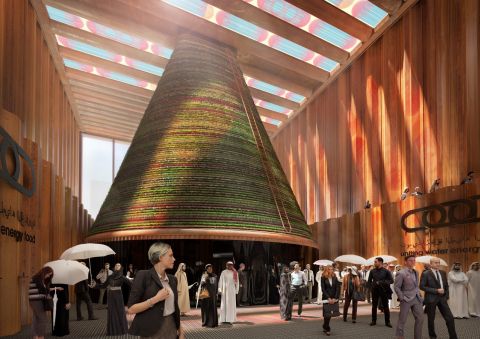
We are happy to announce that WaterSchool will be part of the Dutch pavilion at the World Expo in Dubai.
The WaterSchool, a self-initiated project of Studio Makkink & Bey, is a speculative school designed and organised around water as an essential material, subject, social and political phenomenon. It proposes rethinking of the economic and infrastructural model of education. WaterSchool is displayed in exhibitions around the globe, meanwhile building a curriculum for the subjects to be taught (education) and constructing all spaces needed separately (architecture). Our research is categorised in themes, being Clean, Grow, Harvest, Make, Build and Document.
Community
Within the framework of exhibitions, Studio Makkink & Bey acts as a curator, inviting emerging artists & designers to the WaterSchool community to present their work in thematic exhibitions, inspired by and interpreted at the actual location.
We will present the artists that will contribute to the Dubai exhibition soon.
EXPO 2020 DUBAI will take place from 1 October 2021 to 31 March 2022. The Netherlands Pavilion will be located in the Sustainability District, sharing expertise in the area of water, energy and food.
website WaterSchool
website Dutch Dubai
website World Expo Dubai
illustration by V8 architects
Webshop
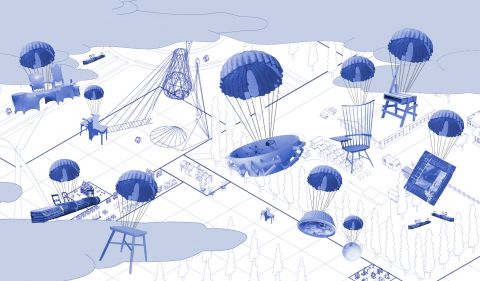
We have opened our online shop , built, owned & operated by us. Offering limited numbers only and often one of a kind designs. Find yourself a dish cloth, a marble plate, a hand painted bowl, a KadE chair, unique collector's items or vintage project surplus.
Next to that we have added some special items to our webshop, all from our own gallery. These are the one-offs, the extra sets or the vintage surplus from projects. We start off with some beautiful Interpolis lamps (every lamp has a unique print), Interpolis tables and chairs and a huge table, originally designed for the KadE museum. Once sold these will never, and by that we mean never, be available again. These are the one and only's, the collectors items.
Looking forward to see you in our online shop. Meanwhile, if you have any questions, or just want to let us know what you think, please do not hesitate to contact us at sales@studiomakkinkbey.nl.
GLASS-works Matter

Studio Makkink & Bey was invited by Circulair Warenhuis to develop a prototype product that uses the residual flows of the circular department store. The studio designed the GLASS-works Matter series, a set of drinking glasses with a total volume of 70 liters, the amount of water in Jurgen Bey’s body. The glasses are collected from the stocks in the shop and engraved with delicate drawings of body organs. Each glass retains its own history and individuality, but at the same time forms a collection that tells the complete story with the other glasses. The engraving is done by the personnel in the workshop, thus learning new skills along the way.
Check out the video, an interview with Jurgen and Pichaya on the why and how or check out more images.
Jurgen Bey and his team focused on making the work process as pleasant and clear as possible. One of the goals is that employees get satisfaction from their work and can learn new skills. For example, the first option of the process consists of the selection of glasses, for which there are no strict guidelines other than that it must be 70 liters in total. In this way, the different sets of glasses will always be different. The second option focuses on the engraving of the glasses, in various levels, so the employees can learn to engrave better and better. Studio Makkink & Bey also designed an embroidered table cloth, matching the collection and to be sold along with the glass set.
About the project
The large influx of materials at recycling companies is unprecedented. This is no different at recycling company Circulair Warenhuis in Leiden. Every year 3 million kilos are collected. Many of the products are sold in the shop, however a considerable part of the unsaleable items is still disposed of as waste.
Circulair Warenhuis wants to make better use of the potential of these residual flows. That is why they have invited 4 designers to research a specific material from this residual flow in order to subsequently develop a prototype product that uses these unsaleable products and that can be produced in the workshops of the Circulair Warenhuis. The aim is to reduce waste disposal and to add value to the residual flows. At the same time, social employment and awareness around this theme is created.
The Circulair Warenhuis is an initiative of cultural producer buro bordo, graphic designers Raw Color and Popma ter Steege Architects. The four designers in this project are Studio Makkink & Bey, Nienke Hoogvliet, Max Lipsey en Fraser McPhee.
New community space in Xiongan, China

Invited by Shenzhen Institute of Building Research (IBR), Studio Makkink & Bey joined the renovation plan for one of neighbourhood centres in the new area Xiongan, China.
The overall topic of the project is 'Harmony Life'. Studio Makkink & Bey renders a new community space, not only a place for gathering groups of activities, but also a place for inheriting and developing culture. All residents are invited to participate in workshops and activities.
Studio Makkink & Bey designed, amongst others, the 'Mobile Square', including the guidelines on the conrete slabs to use for arranging objects in the square, flags, public furniture, screening installations and exercise facilities. Besides the square, a small communal courtyard next to it provides people with an enclosed space for further discussions and idea exchanges. The wall drawings, also designed by the studio, present the blueprint of futuristic lifestyle of residents.
More information
Debut of PolderTV at Dutch Design Week
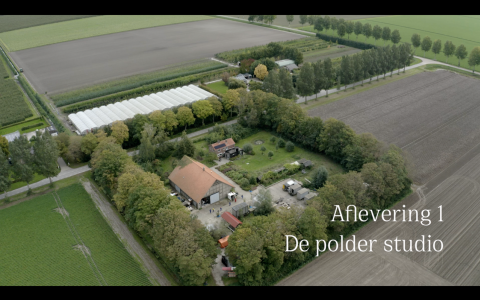
PolderTV is a new tv format about the changing relationship between city and countryside. The launch this week during DDW2020 also marks the beginning of the Polder Triennial 2022, an initiative of cultural strategist Willem Schenk, curator Jules van den Langenberg and Rianne Makkink that shows, discusses, and unpacks ideas about these changing relationships.
PolderTV will have eight broadcasts showing how the Netherlands' most iconic agricultural landscape inspires. For the occasion, our farm in the Noordoostpolder has been set up as a temporary television studio.
You can tune in at PolderTV until Sunday 25 October, daily at 5:55 pm on DDW TV.
Check out all episodes
Rianne is in the first ;)
Renovation in Dialogue
"It is much easier to talk with each other when you are doing something together."
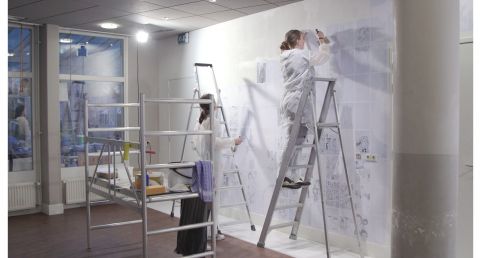
An acrobat draws strokes of paint gracefully on the wall in a handstand. Next to her, a painter is starting his work in blue. A poet creates a connection between in- and outside with a text on the windows. Michou-Nanon de Bruijn, senior designer of our studio, teamed up with Ester van de Wiel to design an alternative renovation method for Cordaan. This project is part of the Embassy of Health presentation during the Dutch Design Week 2020.
Cordaan's small residential care center de Kastanjehof for elderly people needed a refurbishment. The team designed programmatic and spatial interventions in close collaboration with Cordaan, residents and local stakeholders. By deploying the activities as a neighborhood event, an informal care network of residents, associations and local entrepreneurs was built.
By linking the refurbishment to 8 meeting days with cultural activities, an interactive spectacle was created that softens the boundaries between groups and contributes to a gradual line of care.
Watch the videos made in the Kastanjehof on some of the meeting days.
Dutch dining room

Studio Makkink & Bey was invited in a private commision to design a dining room in an art collectors home. Inspired by the Dutch landscape and surroundings of the house, the table is handmade in oak with layered linoleum, depicting the polder, mills, birds, dykes, water, farms and trees. The larger table has 8 made-to-measure oak chairs, the smaller table has a cupboard for after dinner drinks. The carpet was handtufted in India, arranged by Brink & Campman. Images by Pim Top.
More images
Radio Watertoren @ digital Oerol festival Terschelling
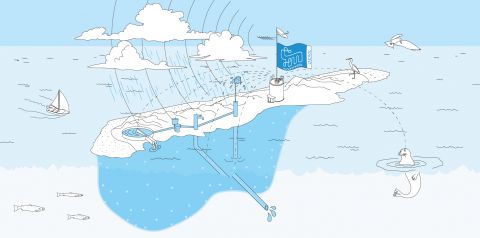
Studio Makkink & Bey and Studio Corvers make a podcast about water on Terschelling at digital Oerol Festival. The project is part of WaterSchool, the self-iniatated project of Studio Makkink & Bey.
Due to corona this years edition of Oerol Festival on Terschelling Island in the Netherlands is rescheduled into an imaginairy island festival.
Where does drinking water on an island in the middle of the salty Wadden Sea come from? Who ensures that the soil does not salinize? How does Terschelling deal with increasingly longer dry periods? Water is increasingly “under pressure” as a result of climate change: flooding, drought, heat stress, shortage of clean drinking water. This presents new challenges, also for Terschelling.
Radio Watertoren is a search for the answer. Studio Makkink & Bey and Studio Corvers will stay on Terschelling for 5 days, from Monday 15th to Friday 19th of June, each day starting at the foot of the water tower in the Hoornse Bos on Terschelling. We talk to water experts and users. This creates a series of water stories that offer a new perspective on this everyday good. You can listen to the podcast episode of that day that same evening at 9pm.
All episodes will be available on WaterSchool Soundcloud channel, starting from the 15th of June, 9pm.
festival website
Pixelated for CS rugs

At the Cologne fair IMM this January, CSrugs introduced Pixelated, a series of rugs designed by Studio Makkink & Bey.
The woolen 3D tufted rugs combine 7 and 11 mm pile height and comes in 20 colour mixtures. The technique used was designed by Studio Makkink & Bey as well. Combining the height of the wool, the colours and the patterns give numerous varieties.
Studio Makkink & Bey considers rugs to be more than just an interior object. They are landscapes in a home, in a physical and now also in a virtual way. Imagine every morning walking into the living room. The rug creates the space where you can comfortably enjoy the morning sunlight with a cup of coffee. By simply scanning the code on the rug, you are invited to a cultural online platform offering you a range of stories and information in art, design and architecture.
website CSrugs
Studio Makkink & Bey designs WAS for Social Label

During Dutch Design Week Social Label introduced the new WAS series, designed by Studio Makkink & Bey. WAS is a rack system and a ceramic bucket with a beeswax cloth.
The laundry rack is an expandable model, starting with a basic drying rack, evolving into a rack for plants and books to an extensive set as a temporary table in your living room or your first desk. The ceramic bucket is taken from an old milk bucket and has a leather handle with a brightly colored cord. Optionally, the bucket can be covered with a beeswax cloth in which you can store vegetables or fruit. WAS connects various social workshops (woodworking, ceramics, upholstery and a bee group) in one concept.
Rianne Makkink: "Doing the laundry is part of a daily ritual, but nowadays our clothes disappear in an anonymous dryer. I miss the hanging laundry both inside and out. If you put your sheets over a drying line outside it suddenly becomes a tent. I like it when objects undergo this metamorphoses and are not defined too clearly.” Image by René van der Hulst
WAS will be available through the webshop of Social Label soon.
More images
Museumnacht Amsterdam 2019 at NDSM Nursery Square

This Saturday 2nd of November 2019 is the Museumnacht Amsterdam! We have some interesting things going on at the NDSM Nursery Square for this event. Check out the full program.
With:
_a first screening by the artist in resident Swaeny Nina Kersaan (graduate of department Fine Art (BEAR) at ArtEZ Arnhem)
_a catering intervention of art collective Comfor+Ball (Bin Koh & Sumin Lee)
_commute-a-long reprise performances at the ferry platform from 19:00 to 21:00h by Smári Runar Róbertsson and Jun Ortega Sánchez & Anna Plowden
_billboard photo series 'Giggles Escaping From a Parked Car Window' by Jules van den Langenberg and Lonneke van der Palen.
Care to join us? Nice: you can also collect your wristbands for Museumnacht at the square.
Press images
Impression NDSM Nursery Square
Rianne Makkink and Jurgen Bey part of curator team IABR 2020
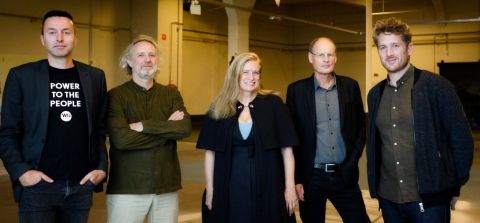
Rianne and Jurgen have been appointed curators Water as Leverage for the Test Site M4H+ Rotterdam at the International Architecture Biennale Rotterdam (IABR). In collaboration with curator George Brugmans, they will develop public programs, events and interventions in and connected to the future of the M4H+ Test Site.
Studio Makkink & Bey is located in the M4H area in Rotterdam and participated in IABR – 2018 with the WaterSchool. WaterSchool 2.0 will be developed during IABR – 2020.
The curator team is now complete and consists of George Brugmans, Rianne Makkink en Jurgen Bey Water as Leverage for the Test Site M4H+ and Thijs van Spaandonk and Robbert de Vrieze, as curators Energy Transition as Leverage in Bospolder-Tussendijken. The Curator Team is chaired by George Brugmans, president of the IABR.
Convince and inspire
The curators want to present well-designed, well-substantiated and promising strategies and best practices in the fields of water management and energy transitions. Showing convincing projects that demonstrate how we can comprehensively transform the challenges our urban landscapes and living environments offer. Showing inspiring examples that stimulate the targeted realization of the United Nations Sustainable Development Goals by telling the story of urban development from a new perspective, thus enhancing people’s ability to act – by offering them real perspectives, which even encourage concrete social activism.
IABR website
Image by Fred Ernst
The NDSM Nursery Square
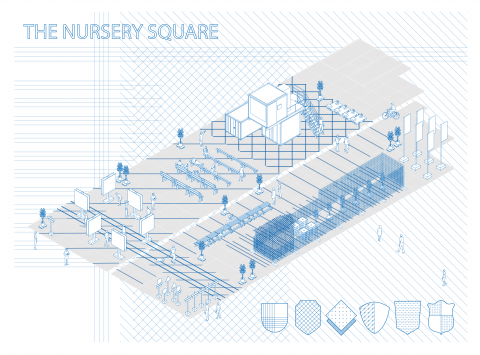
For the upcoming six months the NDSM square in Amsterdam is transformed into the NDSM Nursery Square. In this large-scale art project Studio Makkink & Bey researches public behaviour on the NDSM-wharf and ways in which it can be reset through cultural programming.
Check images of the installation here. We will update our Instagram regularly with new footage as well.
Studio Makkink & Bey and the NDSM-wharf foundation have developed an expanding public square in the NDSM area that will grow over a six months period. Its base is a large floor grid that facilitates different set-ups with the furniture available on site in order to host and stimulate all sorts of activities organized with different intentions.
With unannounced interventions in the neighbourhood, film screenings, site-specific performances and a seasonal ‘artist-in-residence’ at the square – the language and gestures in public space are challenged towards new scripts.
Opening
The official public opening of the NSDM Nursery Square at NDSM plein 1, Amsterdam takes place on Saturday 28th of September 2019, with a performance of the first artist in resident Antoine Guay, a welcome speech by the new director of the NDSM-wharf foundation, Tim Vermeulen, and an introduction on the NDSM Nursery Square by Jurgen Bey and Jules van den Langenberg.
Grid
The base of the Nursery Square is a grid that is literally laid on the ground of the NDSM square. The grid consists of a number of floor plans, with possible arrangements of the available street furniture. The floor plans are stacked and form patterns that indicate how and where street furniture can be placed in order to facilitate and stimulate certain activities.
Part of the area is used to store all elements, with that forming a small park. From this "storage park" the parts will roam the terrain. They can be used as furniture during one of the many festivals, but the furniture itself may result in new programs too. For example, the billboards can serve as screens during film screenings or the concrete floors are stacked and become a temporary stage on which musicians and performance artists can perform.
Artist in residence
Studio Makkink & Bey will invite several architects, designers and artists to research how temporary events in the public space lead to new floorplans.The aim is that after six months an inventory of possibilities is created that map out current and possible future event scenario’s at the NDSM wharf. Artists, architects and designers can stay, meanwhile researching the public space and how to arrange it differently. The residency at the NDSM Nursery Square aims to implement the thinking and work of a young generation of artists, designers and architects in the public space of the NDSM wharf. The artist is invited to develop new site-specific work. The first artist in residence is Antoine Guay.
NDSM-wharf foundation
The NDSM-wharf foundation directs, initiates, curates, connects and stimulates activities at the NDSM-wharf. The goal is that the area is embraced by the city, its residents and visitors as an area with room for the unexpected. An important role is reserved for the art program, of which the NDSM Nursery Square by Studio Makkink & Bey is part of.
More information
Antoine Guay
New sofa for Norya, China
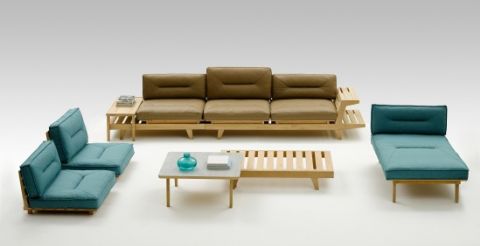
Chinese manufacturer Norya embraced the Studio Makkink & Bey design for a sofa and started the production. This sofa has broken with the traditional arrangement of a living room, reshaping a room for life, where you are able to take a rest, gather with people, eat and dream.
Liberation of the living room
Unlike the other rooms, such as [bed] room, [bath] room, [working] room or even [dining] or [sitting] rooms, the living-room doesn’t suggest any specific form of daily activity. It does however invite us to celebrate the idea of life itself. A living room is in fact a room for life.
With their design, Studio Makkink & Bey aims to liberate living room furniture from its established role. “It’s a landscape changing and evolving according to its actors. It’s a living landscape, living furniture: living room”, Jurgen Bey explains. “Studio Makkink & Bey is interested in the landscape we live in and the landscape we make.”
Domesticating our daily life is about the context of these things. The design for this sofa is questioning how to domesticate our living room and how to domesticate our production landscape. By offering low and high seats, a sofa bed and tables in different sizes and heights one can organise the living room just like a landscape, changing it over time. Whatever your needs, you can configure the room with the various elements, and change it sustainably over and over again.
History
This sofa by Studio Makkink & Bey was part of the installation in 2016 for the Pavilion of the Ullens Center for Contemporary Art in Beijng. Five international designers were asked to design furniture to celebrate the 30th anniversary of the Redstar Macalline company. With the exhibition ‘Design for Chinese Lifestyle’ Redstar Macalline established a multi-cultural platform where Chinese consumers could engage with the ideas of international designers. Studio Makkink & Bey, Kenya Hara, Kengo Kuma, Luca Nichetto and Christina Strand were asked to design for the pavilion. High end Chinese furniture prodocer Norya was impressed by the design and after mutual agreement started production for the Chinese market.
more images
website Norya
In perspective for Dordrecht Nationaal Onderwijsmuseum
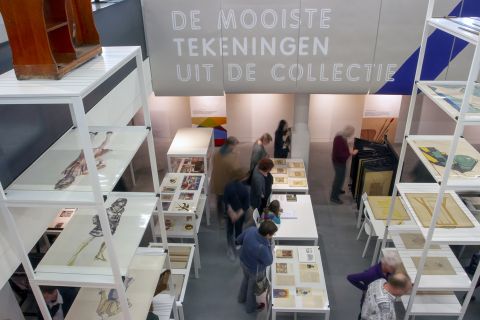
Studio Makkink & Bey designed the exhibition In perspective for the Nationaal Onderwijsmuseum (the national museum of education) in Dordrecht. The exhibition shows the most beautiful drawings from the collection.
more images
The exhibition is situated in the cellars of the building. Studio Makkink & Bey’s answer to the challenge of showing many drawings in a limited space was found in also using the height of the vide: the exhibition was extended vertically by stacking tables and showcases and thus adding horizontal surface.
The design of the exhibition is inspired by drawing tables, drawing tools and drawing paper. The hierarchy of the tables is partly inspired by the table configuration in large gyms during school exams. Old-fashioned poster panel racks were embedded in the exhibition in order to show even more drawings; large rolls of drawing paper were used for signing and extra information. Graphic design by Timothy Liu.
About ‘In perspective’
The exhibition shows the development of drawing as a school subject and tells the story by showing work of students, classified in five time periods. "The first drawing is from the end of the 19th century and it ends with drawings that students made a few weeks ago," says Saskia Noordoven of the museum. In the 19th century, drawing lessons were not without obligation; it was a necessary skill in order to become an artist or craftsman. You had to be able to draw well in order to make your products well later. Nowadays, drawing education is used to teach creative skills.
This change of perspective is well illustrated with the selected 500 drawings, which were never shown to the public before. New work by students is added to the exhibition every quarter.
Visitors can also go to work themselves. The exhibition also offers many DIY assignments connected to the story told in the exhibition. In this way visitors can experience the various disciplines of drawing education over the years.
Facts & figures
In Perspectief / In Perspective
The exhibition can be seen until October 2019.
Nationaal Onderwijsmuseum
Burgemeester de Raadtsingel 97
Dordrecht
website
watch a 3 minute movie (in Dutch) about the exhibition
Attend our Summer-WaterSchool Noordoostpolder
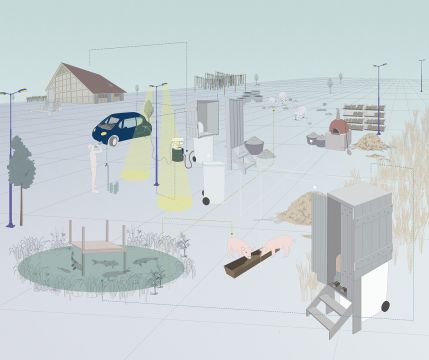
Studio Makkink & Bey is organising a Summer-WaterSchool on their farm in the Noordoostpolder in August. We are happy to invite students, designers and young professionals to attend to one of the two weeklong workshops (Monday until Friday): one starting the 12th of August and one starting the 19th of August 2019.
The intension of this Summer-WaterSchool is to focus on water in a rural and agricultural context by working along one of the six themes of the WaterSchool. These are clean, grow, harvest, make, build and document. For every theme of the WaterSchool Studio Makkink & Bey has chosen a material, a site on the farm and a thesis as the starting point of the working week. Together, these will serve to initiate conversations and designs, guided by a senior designer.
The workweek is a hands-on experience: practical, learning by doing using materials and tools from the farm. You will create in a small group (max 5 persons per group) under guidance of a senior designer guiding you. You will be using crafts and get an insight on the process and techniques of other group members and your guide.
Apply now!
We invite students, designers and young professionals to apply for one of the two weeks in August. There is limited space (5 students per theme), so you might want to hurry ;)
You can apply by sending an e-mail to rianne@studiomakkinkbey.nl indicating:
- the theme you wish to work on
- the reason why you choose this theme (maximum 250 words)
- your cv and two images of relevant projects
Subscription closes on 1st of August 2019.
More information
WaterSchool in Milano

view images of the exhibition
The WaterSchool will be present during the Fuorisalone Milan. You can find us in fabulous Alcova, a former factory building. The ex-industrial space is partly taken over by plants and vegetation, giving it a state of poetic semi-abondonment.
WaterSchool is a speculative primary school designed and organised around water as an essential material, subject and social phenomenon.Within the framework of exhibitions, Studio Makkink & Bey acts as a curator, inviting upcoming artists/designers to present their work in thematic exhibitions and series of lectures.
In this edition Studio Makkink & Bey invited Minji Choi, Aliki van der Kruijs, Atelier NL, Ola Korbańska, Boris Maas, Adelaide Lala Tam, Philipp Kolmann and Giuditta Vendrame to contribute. In the exhibition there is an overview of our research, categorised in themes, being Clean, Grow, Harvest, Make, Build and Document. WaterSchool is a self-initiated project by Studio Makkink & Bey.
WaterSchool at Alcova Milano
opening hours 11 am - 7 pm
Via Popoli Uniti 11-13, Milan
Alcova is situated adjacent to Stazione Centrale and in front of stop Rovereto, red metro line (appr. 10 minutes from Duomo)
QR tapestry in Milano
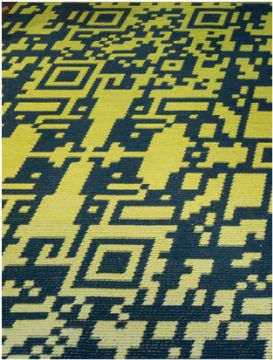
During this year’s Salone del Mobile in Milan, Carpet sign will launch a daring collection of limited-edition rugs called Freedom. Studio Makkink & Bey designed the rug QR tapestry with many layers.
Earlier furniture designs from the studio’s own archive were used to decorate the rug. “To emphasize that our furniture pieces become storytellers, they are depicted in the coarse pixels on old-fashioned computer games. You can hardly recognize them anymore”, Jurgen Bey says.
A magazine in pixels / A pixelated magazine
A QR code is included in the design, made in the same visual language as the studio’s formerly designed pixelated furniture. Scanning brings you to a whole new dimension: an online gallery also designed by the studio. ”So when lying on the floor with a tablet or a smartphone, it should be possible to use the rug as a portal to digital information about the designer.” For now this code will bring you directly to an online gallery with the studio’s pixelated furniture and a section for the studio’s selection of music, podcasts, documentaries, poetry or stories. “It would be great if in the future you could get to know the designers’ world zapping from a rug. Perhaps in the form of a magazine, of which you as a follower receive a new edition every month.”
Collection
The Freedom collection, under the art direction of Richard Hutten, contains designs from the ‘crème de la crème’ of Dutch designers. Next to Studio Makkink & Bey and other product designers also an architect, a graphic designer and an artist contributed to the collection, among which Irma Boom, Joep van Lieshout, Sabine Marcelis, Christien Meindertsma, Jólan van der Wiel, MVRDV architects, Richard Hutten and Wim Bos.
Alcova Milano
The new collection will be displayed in Alcova, located at Via Popoli Uniti 11-13, Milan. Opening hours from 9th until 14th of April 2019 from 11:00-19:00h.
CompostKlikoToilet on Dutch television
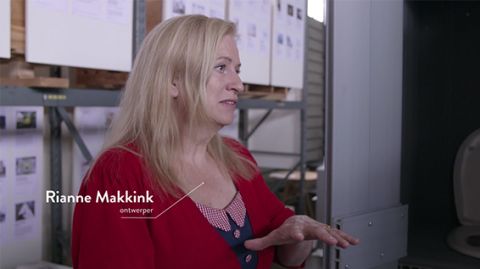
The Dutch television program 'Voor de vorm' investigates the shape of everyday objects. In this episode Dutch designer Christien Meindertsma looks at our toilet and visits Studio Makkink & Bey in Rotterdam to talk about their CompostKlikoToilet.
Rianne Makkink explains that we should not look at our own excrements as waste, but as harvest. See the interview with Rianne here.
Makkink & Bey’s design is a compost bin toilet where human faeces are reused, being part of a circular landscape. It not only saves water, but also provides in reusing human waste, including its many nutrients for the soil. It is constructed from a white wheelie bin in which Dutch households separate their waste. On top of the white wheelie bin is a box that allows you to relieve undisturbed. After your visit you throw ashes on top to neutralize the odor, covering the faeces and enriching the human manure. The collected urine, drained at the bottom of the chest, can be used for producing electricity.
'Voor de vorm' is made possible by the Stimuleringsfonds Creatieve Industrie.
OCT Gallery China opens overview exhibition Makkink & Bey

The exhibition Land[E]scape in the renowned OCT Art & Design Gallery in Shenzhen, China opened the 29th of September 2018. The exhibition shows over 30 unique pieces of the studio’s private collection. The OCT Gallery is celebrating her 10th anniversary with this exhibition.
Images of the exhibition and opening
WaterSchool at the Istanbul Design Biennial

The WaterSchool, a self-initiated project of Studio Makkink & Bey, was invited to be present at the 4th Design Biennial in Istanbul. WaterSchool is a speculative primary school designed and organized around water as an essential material and subject. The WaterSchool proposes a rethinking of the economic and infrastructural model of education: this school could produce everything it needs to function onsite through small-scale industrial collaborations, and also sell its surplus to the public.
The installation includes an introductory film in which the director of the WaterSchool narrates a day in the life of the school. Six members of the school give further insight in short podcasts into how the WaterSchool would function. The exhibition also shows how artists and designers can be integrated into the curriculum and design of the school.
Images
Waterlab NAP

With the opening of the monument ‘Deltawerk //’, designed by RAAAF +Atelier de Lyon, it is celebrated that Waterloopbos is now a Rijksmonument.
Natuurmonumenten organised a ‘Lights on’ walk, a walk through the forest that tells the unique story of the scale models of the Waterloopkundig Laboratorium (water research centre), that has been out of use since 1996. Studio Makkink & Bey, in cooperation with Maaike Engels, was invited to make an installation and movie to tell the story of the WaterLaboratorium.
Next to the (former)visitors centre, the studio designed an installation with aluminium boats on various levels of the North East Polder, the maximum level underwater is -4,5 meter. The movie shows an overview of the start of the NorthEastPolder and the research and projects of the Waterloopkundig Laboratorium that took place here.
Images
Land[E]scape exhibition in OCT Gallery in Shenzhen, China

We are happy to announce our exhibition in the renowned OCT Art & Design Gallery in Shenzhen, China from 29th of September 2018 until 6th of January 2019.
Land[E]scape: a land scape beyond landscape
With Land[E]scape Studio Makkink & Bey intends to demonstrate how a single product or design thinking can redefine a landscape. The exhibition shows some of the characteristics of the studio’s work: creating macro impacts with a micro innovation and using a single object to present a complex context. Next to that the exhibition shows over 30 unique pieces from the studio’s private collection.
The exhibition explores Studio Makkink & Bey’s vision on the phenomenon of landscapes and how these can be reimagined, repositioned and redesigned through interventions on both smaller and larger scale. Landscapes are ever-evolving carriers of information of both natural and cultural sorts. Any change within them, however small it might be, affects the landscape as a whole. On the other hand, any change on the scale of a landscape affects all it accommodates. If seen from the context of design this means that one single product can progress into a project of a larger scale, motivating its own setting through generating its own landscape. Yet, a project on the scale of urban planning can equally produce a series of products related to and derived from their original context.
Land[E]scape, a portmanteau of landscape and escape, is divided into four major sections: the Drawing Room, the Model Room, the Living Room and the Classroom. By following the designers’ view, the exhibition showcases various scenarios. From speculative blueprints of imaginary future landscapes in the Drawing Room to a landscape hovering in between idea and reality in the Model Room. The Living Room features products and projects developed, each representing a vision on the future of living and domesticity in general. These interventions range from small-scale architecture to tableware. Lastly, the Class Room presents two proposals for future schools, each developed starting from and celebrating a material: the WaterSchool and the Seaweed Site. It represents a strategy currently being developed by Studio Makkink & Bey, in which they aim to bring future visions to reality, supported by the grand network they have accumulated throughout the years.
Just like travelling, visitors are invited to ‘escape’ from the ordinary everyday reality, only to get lost in the presented Land[E]scapes. At the end of the ‘journey’, when it is time to ‘go home’, it is Studio Makkink & Bey’s wish that visitors take the new perspectives back to their reality. And with that rediscovering the landscapes around them and slowly integrate the new ideas into their daily routines.
Facts and figures
OCT Gallery
9009-1 Shennan Ave
518053, Shenzhen
Exhibition
from 29.09.2018 until 06.01.2019
Opening hours
daily from 10 a.m. to 5 p.m.
Not to miss: last two Fridays of WaterSchool

We kindly invite your for the last two sessions of WaterSchool:
Friday 29th of June 16:00 - 18:00 o'clock - theme 'Build' - central question is how cities and buildings can be adapted to cope with increasing rainfall as a result of climate change.
Guest speaker Istvan Kenyeres, president of the Biopolus Institute (Budapest, Hongary), has realised more than 100 biological water recycling systems in the past 20 years. He will tell us about living biological factories as hubs to combine water re-use with biological production in populous surroundings. Joost van der Hammen (Nelen en Schuurmans) will provide insights about rainwater management in cities by explaining about the the Watersquare in Rotterdam. RO&AD Architecten will present their project Mozes bridge, a bridge of wood that follows the contours of a fort.
On Friday 6th of July 16:00 - 18:00 o'clock is the wrap up manifestation with the theme 'Document'. We will talk about how to document and archive in a digitizing society. The exhibition will be complete and we have invited guest speakers Rogier Arents, Dolf Broekhuizen en Giuditta Vendrame.
More information:
Friday 29 June | Build subscribe
Friday 6 July | Document subscribe
Location:
Studio Makkink & Bey, Marconistraat 85, Rotterdam
Open:
14.00-19.00 o'clock, presentations between 16.00-18.00 o'clock
All presentations will be in English.
Facebook
Publication series How May I Help You?

In order for new dialogues, collaborations and commissions to occur Studio Makkink&Bey instigates and developes an ongoing series of publications using the new web tool www.howmayihelpyou.nl.
The first five issues include a new essay by designer Erez Nevi Pana on what it means to design in a vegan way, a plea for designers and artists to find room to manoeuvre in reality and make use of informal possibilities by researcher Sophie Krier, a text on how interior objects and artefacts transmit ideologies by designers Gabriel A. Maher & Isabel Mager, a song on being a temporary resident by artist Klaske Oenema, an essay by museum director Guus Beumer on some of the transitions Dutch Design has gone trough since its establishment in the early 1990s and a fictional call for applications at Hieronymus Bosch' Studio by producer Jeannette Petrik.
The publication series How May I Help You? project frames the knowledge, people, things and places encountered by the Dutch design collective during fifteen years of artistic services and beyond for the public. In addition to the edited publications, the web tool welcomes users to compile their own personalised publications by making selections using a logbook function.
How does it work?
COLOPHON
Directors:
Jurgen Bey, Rianne Makkink
Editor-in-chief:
Jules van den Langenberg
Editor:
Daan Veerman
Website & graphic design:
atelier Arthur Haegeman & We became aware (Tomas Lootens & Valentijn Goethals)
Co-publisher:
Publication Studio
The project is made possible by the financial support of the Mondriaan Fund.
IABR event: WaterSchool working exhibition in our studio in Rotterdam
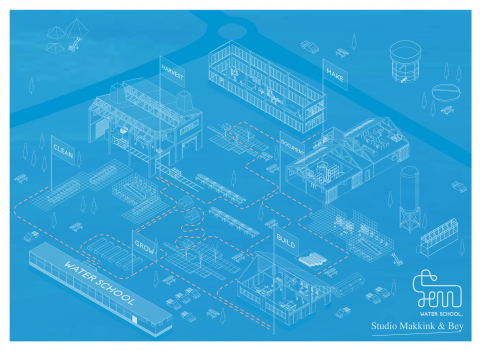
The WaterSchool is a working exhibition to develop a future school which will be opened in the heart of the M4H district in Rotterdam, in the workspace of Studio Makkink & Bey. It will be open for six consecutive Fridays, during the six weeks of the IABR, from 14.00 to 19.00, starting from the 1st of June.
Within each of the Fridays, the topics of water and education will be explored from different angles, according to a theme. The themes for the Fridays are: Clean, Grow, Harvest, Make, Build and Document.
A selected team of employees from Studio Makkink & Bey will perform research on these topics and how to integrate them into the architecture and curriculum of the School, in order to present their findings each Friday.
Paired with this, lecturers from the cultural sector, the industry and the government will share their views on water and education within lectures and discussions, which will take place every Friday from 16.00-18.00 o'clock.
Using the medium of an exhibition and lectures as a tool, Studio Makkink & Bey aims to connect companies, governmental bodies and designers working on topics related to water and education. In doing so, they aim to create an active archive and network, branching out from the hinterland of Studio Makkink & Bey, being the M4H district, which is to be activated and used to found the WaterSchool.
More information:
Date and themes:
Friday 1 June | Clean subscribe
Friday 8 June | Grow subscribe
Friday 15 June | Harvest subscribe
Friday 22 June | Make subscribe
Friday 29 June | Build subscribe
Friday 6 July | Document subscribe
Location:
Studio Makkink & Bey, Marconistraat 85, Rotterdam
Open:
14.00-19.00 o'clock, presentations between 16.00-18.00 o'clock
All presentations will be in English.
Facebook
Strengthening Bartholomeus’ role in its neighbourhood

Bartholomeus Gasthuis, Aorta architecture centre and the Creative Industries Fund initiated an interdisciplinary research project aiming to strengthen the chain of well-being, housing and care of a caring home in Utrecht. Six designers from different disciplines were commissioned to develop a new strategy. Senior designer of Studio Makkink & Bey Michou Nanon-de Bruijn to be one of them. Central question: How can an integrated chain of well-being, housing and care be translated in an urban planning context and in the layout of spaces in the building. And for the Bartholomeus Gasthuis in particular?
Change
The Dutch healthcare system is changing. People age older and stay at home longer. Savings are being made in healthcare systems. Due to major law changes, people in need of care are encouraged to use their own network. This all means that there must be a good social network and access to the right facilities…… crucial conditions for staying physically, emotionally and socially vital. The ambition of the Bartholomeus Gasthuis is to create a gradual care line: to soften the step to the Gasthuis, but also to facilitate services for elderly to be able to stay longer at home in the city centre of Utrecht. Therefor the goal of research was to develop an integrated and accessible support with a low threshold for elderly people in the neighbourhood. The research was to offer insights into the programmatic, spatial and economic aspects of the assignment and investigate how to broaden and deepen the built-up precautionary system of the Bartholomeus Gasthuis.
4 strategies
The team studied the surroundings and neighbourhood, interviewed employees and elderly and talked with entrepreneurs and various experts. The designers then developed four strategies.
1. Alibis for social contact
By providing people 'alibis' for social contact, they are more inclined to interact with their neighbours, without feeling helpless. If you know what people value, you can use those values to connect. In this way we are able to design a new generation of neutral networks based on mutual interests, not age.
2. Outside-Barth club
A club of local businesses that offer their services to local residents who need help to a greater or lesser extent. The Bartholomeus Gasthuis trains them to provide good service to needy local residents and contributes to their business by bringing new customers. Within this network, both small businesses and local residents can 'survive' independently for longer.
3. Barth for the neighbourhood
Barth for the neighbourhood turns the Bartholomeus Gasthuis inside out to lower the threshold for neighbourhood residents. This means to separate current attractions and develop a supportive, open program and by this inviting people from the area. Over time boundaries will gradually become less sharp and transitions will become more gradual.
4. Club of clubs
By using the qualities of the courtyards, a layered network of attractive meeting places is created for residents in the neighbourhood. This can be a place to set up informal clubs, based on shared interests. Although these clubs are based on fun and passion, they also provide alibis for more care-related questions now and in the future. After all, you can easily ask a friend something because you have already built up a bond during cooking or gardening.
The first phase of the research was published in a special magazine, presented during the Dutch Design Week 2016. A short summary (in Dutch) of the results of the second phase is shown here. The designers in this research project are: Willemieke van den Brink (social designer), Wies Harmeling (interior architect and teacher HKU), Dolf Jorissen (architect), Ester van de Wiel (landscape architect), Meintje Delisse (architect Heren 5) and Michou Nanon de Bruijn (Studio Makkink & Bey).
An ounce of practice is worth a thousand words
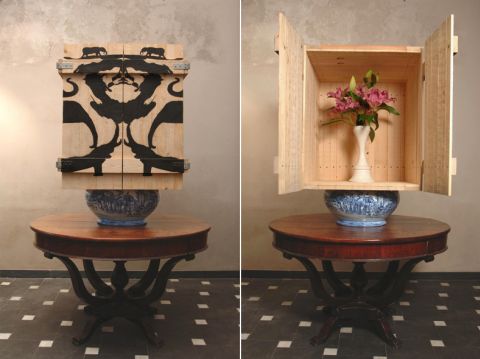
Studio Makkink & Bey and Piasa Paris have joined forces to realise a grand auction of unique pieces, prototypes and limited edition objects of the studio on Thursday 19 October 2017 in Paris. The warehouse of the Dutch contemporary design practice is reorganised in order for a new, self-initiated project to arise in addition to their ongoing product-, interior- and exhibition design projects.
“I remember spring cleanings at my family’s house when I was a child. My mom moved everything literally out of the house into the garden; we cleaned everything thoroughly, all walls were redecorated, the carpets shampooed. This was also the time we were to refurbish the house completely. Together we would decide which pieces of furniture would stay or go and where to put it. It felt like a completely new home, giving new ideas and headspace at the very same time”, founder Rianne Makkink says.
“After the founding of our studio in 2002 we felt like doing the same in our workspace”, founder Jurgen Bey continues. “We have kept artists proofs, first edition pieces and prototypes for years. Some of these pieces already ended up in museums and private collections. Some of them were placed in our home, some remained in our studio, meanwhile shaping our life and work. A lot of pieces were carefully stored in our warehouse, but it now feels they need new owners as we develop our practice towards new grounds”.
By sorting the warehouse and bringing over 60 objects to a grand auction the studio is making space for the new ideals the team wants to unfold from the beginning of 2018. A part of the Rotterdam based workspace will be programmed into an environment for the development of a self-initiated project titled ’WaterSchool’.
Education being one of the consistent theme’s in the studio — currently with Rianne Makkink involved in the Design Academy Eindhoven Social Design Masters department and Jurgen Bey as director of the Sandberg Institute Amsterdam, Masters of Applied Arts and some of their studio members as visiting tutors in Dutch art, design and architecture education. Now the critical design practice will further develop this terrain. The auction on invitation by renowned auctioneers Piasa enables all buyers of the original pieces to become partakers in the initiation of the ‘WaterSchool’ project.
The ‘WaterSchool’ should become an environment for learning by examples. “From the unrealised projects developed within the studio we have chosen ‘making school’ as the first self-initiated project to invest in. The school as a landscape and interior that aims to improve its water household. The ‘WaterSchool’ project will be an educational landscape organised around and based on celebrating water by carefully and consequently questioning the industry and its market”.
Making school and by doing so putting water on the global agenda, The ‘WaterSchool’ should become a landscape developed by crossbreeding Dutch and Indian knowledge making culture in both nations in collaboration with various craftsmen and small industry.
Facts and figures
Piasa Paris will host the landmark sale of unique creations by Dutch architect/designer duo Studio Makkink & Bey, featuring around sixty unique pieces: prototypes, artists proofs and one-offs, chosen from among the studio's most innovative and museum works.
Viewing on the following dates:
Saturday 14th October 2017 from 11 am to 7 pm
Monday 16th October 2017 from 10 am to 7 pm
Tuesday 17th October 2017 from 10 am to 7 pm
Wednesday 18th October 2017 from 10 am to 7 pm
Thursday 19th October 2017 from 10 am to 12 pm
location: 118 rue du Faubourg Saint-Honoré 75008 Paris
The catalogue with all the pieces will be available approximately two weeks in advance.
Auction
Thursday 19th October 2017 06:30 pm
118 rue du Faubourg Saint-Honoré 75008 Paris
For more information & images
PIASA - 118 rue du Faubourg Saint-Honoré 75008 Paris
T :+33 (0)1 53 34 12 95
website
Design Diorama premieres in Archive interpretations, HNI Rotterdam
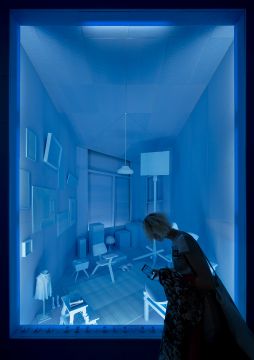
from 8th of September through 29th of October 2017
‘Design Diorama: the archive as a utopic environment’, the exclusive installation at the 2016 London Design Biennale, will be part of the exhibition ‘Archive interpretations’ in Het Nieuwe Instituut in Rotterdam. The opening of the exhibition on the 7th of September starts off the new exhibition season of Het Nieuwe Instituut with a celebratory evening with conversations with Jurgen Bey and others.
From London Design Biennale to Het Nieuwe Instituut
Studio Makkink & Bey was invited by Het Nieuwe Instituut, museum for architecture, design and digital culture, to represent the Netherlands in an exhibition at the 2016 London Design Biennale to give their vision on the central theme ‘Utopia by design’ and how design can contribute to a new world. Inspiration for the presentation was the central question how an archive – being a historical knowledge system – can be seen as a utopian world. The studio research on traditional archives like libraries, museums, rarity cabinets, botanical gardens and collections resulted in their Design Diorama.
Utopia from a drawer
The studio chose their personal archive as the starting point for the project. Thus, the Diorama became a collection of personal objects that individually tell their own story. In bringing all objects together, connections, contrasts and a network of places, people and crafts is shown. “Ultimately, with our installation ,we want to show the importance of tangible objects in an increasing digital world”.
The installation translates the international network of Studio Makkink & Bey into a three-dimensional blueprint of their living room: a replica of their own collection. The installation implicitly refers to the living and working environment of every designer — an environment that, as in the case of Makkink & Bey, functions simultaneously as a personal archive of objects by former studio colleagues, internees, designers, artists, architects and themselves. Accompanying the installation is an online environment that translates the international design network of Studio Makkink & Bey into a digital archive.
About Archive Interpretations
Het Nieuwe Instituut manages one of the biggest architecture collections in the world. Since 2014, HNI involves designers, artists and researchers in opening up its collection – for example, through commissions in the series New Archive Interpretations – and entices them to explore the role of an archive in their work. This initiative has resulted in some remarkable projects that have been presented at home and abroad, but not in the institute itself. The exhibition Archive Interpretations now offers the perfect context to now bring home four different projects, amongst which Design Diorama of studio Makkink & Bey.
More information
Information exhibition.
Information opening.
image by Thijs Wolzak
Studio Makkink & Bey designs and co-curates Food Revolution 5.0 Design for tomorrow’s society for Museum für Kunst und Gewerbe in Hamburg
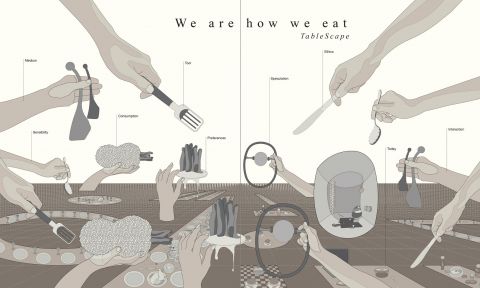
The exhibition Food Revolution 5.0 from 19th to 29th of October in MK&G Hamburg sheds light on one of the most pressing issues of the 21st century: What will we eat in the future? The exhibition takes a critical look at the global food industry and presents pioneering visions, ideas and designs contributed by over 30 international designers, architects, and scientists. The exhibition design and co-curating was entrusted to studio Makkink & Bey.
Design exhibition and co-curator
Studio Makkink & Bey designed the entire scenography and co-curated the exhibition in close cooperation with head curator Design of the museum, Dr. Claudia Banz. The studio also exhibits a design for an innovative cattle farm ‘FreeRangeShelter’. The roof of the compost stable contains a volume in which the cattle keeper resides.
“We started working on this project about 1 year ago, after a personal invitation by Dr Banz”, says Rianne Makkink, senior designer and co-curator of the exhibition. “Starting with investigating the theme and asking questions is how we prefer to start composing an exhibition. Placing it in the broader perspective of society, technology, science, economy, time and nature. That was the exact idea of MK&G for our cooperation.” Their joint study resulted in the context of the exhibition and determination of themes from where both curators could invite designers to give their vision or present existing projects.
Next to her co-curatorship, Rianne Makkink and her team designed the entire scenography of the exhibition; from lay-out to designing all exhibition elements, including the designs of the tutorial backgrounds. All projects are put ‘in a bigger picture’ to give them a context.
See more images.
Venue:
from 19 May to 29 October 2017 | Museum für Kunst und Gewerbe (MK&G), Hamburg
Unique exhibition design for Love is love, wedding bliss for all à la Jean Paul Gaultier
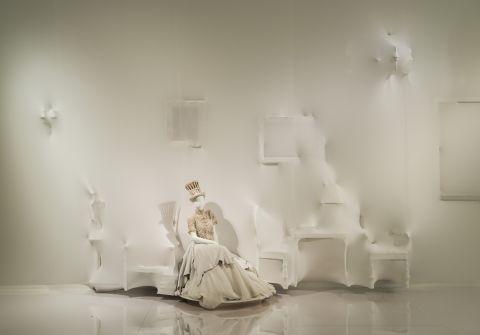
Love Is Love features a spectacular audio-visual and musical design that celebrates Jean Paul Gaultier’s boundless imagination and twenty years of haute couture. The exhibition features wedding gowns and suits created between 1990 and 2017. Presented in the Contemporary Art Square, the exhibition is organized around a monumental wedding cake with female and male mannequins: couples of every gender and orientation.
The work of Studio Makkink & Bey is featured with an installation of furniture and objects that have been entirely covered in an immaculate elastic membrane, like a cocoon. The concept of the installation is based on the re-appropriation of existing contextual elements. Traces of chairs, tables, suitcases, lamps, paintings and an exit soften the space and create an environment in which the mannequins come to life at the same time.
The studio also collaborated on the Maison Jean Paul Gaultier’s spring-summer 2014 fashion show and haute couture salons, as well as for the MMFA’s retrospective presented at the Grand Palais in Paris in 2015. Interestingly enough, the MMFA’s collection contains a lamp and an armchair designed by Jurgen Bey as well.
See more images.
Venue: The Montreal Museum of Fine Arts, 1380 Sherbrooke Street West, Montreal, Quebec
Image by Denis Farley.
CompostKlikoToilet on show in Kerkrade (NL) ‘Everything you wanted to know about toilets, but were afraid to ask’

“We are raised with the idea that our own excrements are disgusting and unhygienic, but it is not that bad”, says Rianne Makkink from Studio Makkink & Bey. “Our urine is actually very clean, it creates phosphates that we will need desperately in the near future. Phosphates will become valuable, like water”. Coming from a farm, Rianne always wondered why we flush away our excrements down the sewer, along with clean and valuable water. Makkink & Bey’s design CompostKlikoToilet is a compost bin toilet where human faeces are reused, being part of a circular landscape. It not only saves water, but also provides in reusing human waste, including its many nutrients for the soil.
The CompostKlikoToilet is now on show in the exhibition ‘Everything you’ve always wanted to know about toilets, but were afraid to ask’ at Cube Design Museum in Kerkrade.
Wheelie bin
The CompostKlikoToilet is constructed from a white wheelie bin in which Dutch households separate their waste. “A different wheelie bin has been added to our households almost annually in the last couple of years. Adding a compost-bin-toilet should be fine as well”, says Rianne Makkink. On top of the white wheelie bin is a box that allows you to relieve undisturbed. After your visit you throw ashes on top to neutralize the odor, covering the faeces and enriching the human manure. The collected urine, drained at the bottom of the chest, can be used for producing electricity.
Makkink wonders if their concept on the compost-bin-toilet and the separation of people’s excrements will succeed in the Netherlands. “A lot needs to change for this design to find a wider application in our lives, mostly in the mentality of people”, Makkink says.
See more images.
Venue:
Everything you always wanted to know about toilets… but were afraid to ask - A design manifestation on the design principles of our elementary need.
19th May until 19th of November 2017, Cube Design Museum, Museumplein 2, Kerkrade; open daily from Tuesday till Sunday, 10:00 till 17:00 hrs.
House of arts in KAF, Almere

Whilst preparing the exhibition ‘House of Arts’, the farm of Studio Makkink & Bey in the Noordoostpolder served as a workplace for ‘designers & artists in residence’ who together developed this exhibition for Kunstlinie Almere Flevoland (KAF). KAF Expo shares new visions on the city with exhibitions and presentations. With the ‘House of Arts’ exhibition KAF celebrates the opening of the new building in Almere by SAANA architects.
A sharp analysis of the actual world issues, like natural disasters and refugee issues, resulted in smart design solutions that use the full potential of a district, building or product in this complex situation. In the exhibition a number of objects are being showed in blue foam as so called wishes for the future, being real or speculative. Every object serves as a question that will be studied by ‘the designers & artist in residence’. The exhibition is emphasizing the design strategy of Studio Makkink & Bey that urban planning, architecture and landscape architecture are indissolubly bound to product design.
‘House of Arts’ in Kunstlinie Almere Flevoland (KAF)
27th January until 2nd of July 2017
opening hours:
Tuesday – Saturday 10 am to 10 pm; Sunday 10 am to 6 pm
More information
image by Pim Top, Rotterdam
Polderscape
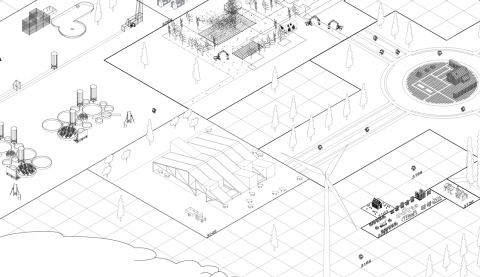
In 2007 Studio Makkink & Bey, together with, amongst others, Atelier NL, Maarten Kolk, Lucas van Vugt, Florian Visser, Yep Wiersma and stichting Herbergen, activated the project ‘designers & artists in residence Noordoostpolder’. The starting point for this project was the Noordoostpolder itself for research and design. The Noordoostpolder is a region in the province Flevoland, Netherlands. Now, 10 years later, the landscape and property development of the Noordoostpolder will again be the focus point in the ‘House of Arts’ exhibition. The farm and premises of Studio Makkink & Bey in Kraggenburg, Noordoostpolder, will again serve as laboratory. In past years the province of Flevoland in general and especially the polder has resulted in a couple of interesting research projects within the studio. In Polderscape all projects have been brought together and become a new ‘working landscape’ in the future polder.
Jurgen Bey recreates the Kolenkitbuurt with ONZIJN
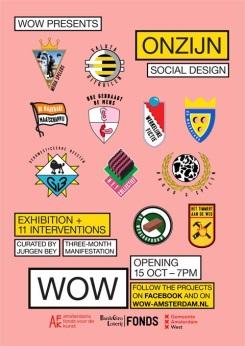
Design for an event? Designer Jurgen Bey decided to engage in a dialogue. As of 15 October, the WOW building in the Amsterdam Kolenkitbuurt is hosting a three-month manifestation called ONZIJN.
Curator Jurgen Bey of Studio Makkink & Bey selected eleven inspiring projects: with their work artists and designers react to the neighborhood of the WOW building. In the dialogue between environment and creator, every artist stands for a different theme that is based on WOW as a temporary habitat. With his choice, Bey reflects to the context of WOW as a hotel and meeting place, but also as a home for fifty young artists.
Jurgen Bey was asked to make a selection of inspiring artworks / projects and thus to reflect on the definition of social design, providing a platform for designers to show how social dialogue can be initiated by critical work. For the duration of the exhibition, the WOW building transforms in one large exhibition space.
For more information about the exhibition click here.
Making School
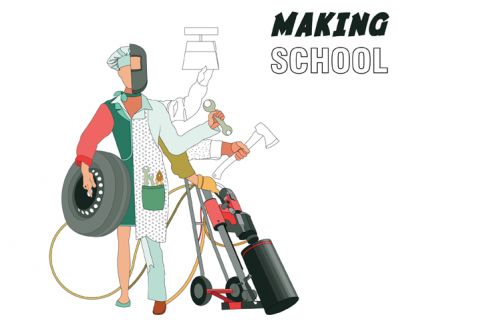
Studio Makkink & Bey was asked to curate and design the exhibition ‘Making School’ in The Veemgebouw Eindhoven during Dutch Design Week (DDW) from 22nd to 30th October. Together with Dirk Osinga (do | ob) they designed a landscape of tables where the public can see, but also join the thirteen research projects. Videos, models, publications, online platforms and products show the results of their investigations.
'Making School’ examines the future of education for young people. In a rapidly changing society, it is important to develop a new vision on learning. The exhibition 'Making School’ shows how the knowledge and skills of the creative industries can contribute to such a new vision.
During DDW thirteen multidisciplinary teams of designers, cultural institutions and educational professionals show their studies in this area. By exchanging ideas with teachers, students and the public, the exhibition was further developed during DDW. Making School is an initiative of the Creative Industry Fund. For more information click here.
XML + Jurgen Bey nominated for the ARC16 Furniture Award
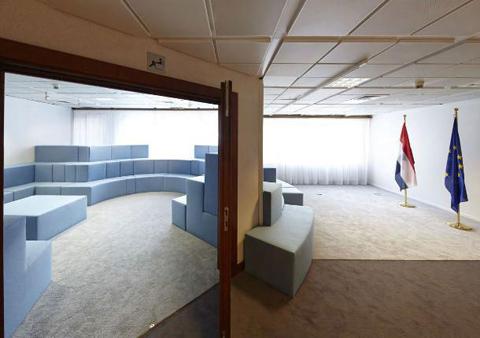
XML+ Jurgen Bey are nominated for their design for the European Council in Brussels. The other nominees are Studio Farris Architects and Studio Samira Boon.
The ARC16 Furniture Award is given to the best seating design, series or system, for use in the work area and made in the previous year. The Dutch ARC Award is a yearly event, covering 7 categories amongst which interior, architecture, furniture design, innovation and young talent. The winner will be chosen 17th of November during a festive event in the Kurhaus in Scheveningen.
For more information on the ARC awards check the site.
Design Diorama : The Archive As A Utopic Environment
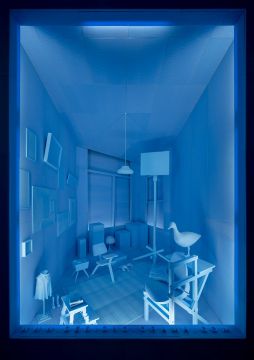
Design Diorama, London Design Biennale
7 September – 27 September 2016
Curator & Exhibition Design: Studio Makkink & Bey Commissioner: Het Nieuwe Instituut
Studio makkink&bey present design diorama: the archive as a Utopic environment, a three-dimensional blueprint of the personal salon of the studio’s founders, rianne makkink and jurgen bey. this contemporary diorama – originally a picture viewing device through which an interior is viewed – is a replica of their archive at home. it consists of a space filled with blue foam copies of objects by former studio employees, freelancers and interns as well as products and artefacts from various other designers, artists and architects. parallel to the temporary physical diorama installation, on display at the london design biennale from 7 to 27 september 2016 in somerset house, a permanent digital index has been developed and can be viewed online.
Photography By: Thijs Wolzak
Jurgen Bey’s says goodbye to Janny Rodermond
On Monday, August 29th Janny Rodermond said goodbye as the director of the Stimuleringsfonds voor creative industry. Various speakers presented views and projects during an inspiring afternoon.
With his talk ‘Think as an artist, act like industry and be a learning institute’ Jurgen Bey presented his view on the future of the creative industry. Where does the future live? Who is responsible? How does the cultural landscape look like? What is the new reality? Jurgen Bey does not answer all questions, but questions the answers while looking at work of various artists.
Want to see his talk? The talk is in Dutch with no subtitles.
BAL! at the Soestdijk Palace
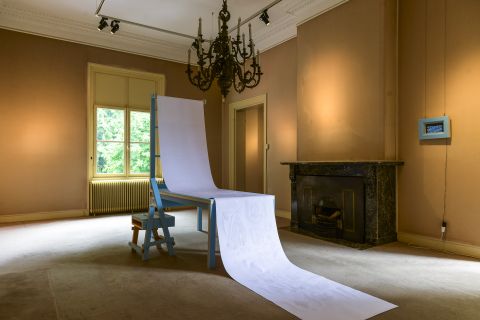
From 25th of June through the 25th of September the palace of former Dutch Queen Juliana was transformed into a place where more than 40 leading artists and designers presented a new piece / work especially made for this occasion. The exhibition called BAL! was curated by Anne van der Zwaag.
Studio Makkink & Bey was given the ‘adjudantenkamer’. The installation shown depicts a dinner for the adjutants before the royal ball. Whilst eating, the adjutants quickly adjust the coronation mantle (koningsmantel). A new pattern is traced onto the red velvet using a tracing wheel and the mantle is adjusted to fit the monarch’s needs and shape. When all of them get up to go to the ball, they take the amended mantle with them, leaving the tablecloth behind as the only tangible memory of the dinner. All the exchanged stories are etched into it using the same tracing wheel that was used to adjust the mantle.
Uproot Rotterdam

Uproot Rotterdam @ Museumpark: a pop-up sculpture park from 1st June – 21st August 2016
In the summer of 2016 Rotterdam had its first pop-up sculpture park: Uproot Rotterdam. Studio Makkink & Bey studied the role art played in reconstructing Rotterdam after World War II by looking at physically uprooted sculptures. In addition to this retrospective Uproot Rotterdam also showed the contemporary city dynamics and what the changing future might bring. By curating a side program Studio Makkink & Bey invited the neighbouring museums, residents as well as a new generation of designers and emerging artists to present themselves.
Uproot Rotterdam was organized in the framework of ‘CBK Rotterdam Celebrates the Arts and the City’, as part of ‘Rotterdam celebrates the city!’ The project was kindly supported by the city of Rotterdam and foundation de Loodsen.
Temporary Fashion Museum Collected By...

From 13 September 2015 until 8 May 2016, Het Nieuwe Instituut, Rotterdam, NL
Exhibition design by Studio Makkink & Bey i.o.v. EventArchitectuur, Het Nieuwe Instituut
There can be no museum without a collection. For this reason the largest gallery in the Temporary Fashion Museum is devoted to a series of unique collections, from the private and professional to the public and commercial. From the private haute couture collection of Eva Maria Hatschek to a public, commercial archive in the form of a vintage store, assembled by Ferry van der Nat, with iconic pieces from the history of Dutch and international fashion. Visitors can choose how they wish to experience these displays. Depending on thie condition and status, some of the pieces can be touched, tried on and purchased.
Opening POP-UP Spring Place Cafeteria NY
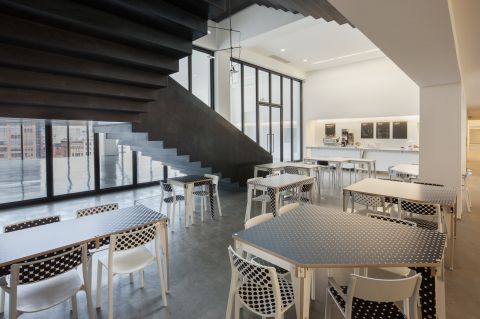
Since their House of Partsproject in 2009, Makkink & Bey have explored cutout solutions, which develop, into furniture pieces. The concept is to produce drawings with an industrial CC process that can be made locally and customized to suit different functions, hence creating flat-pack pieces, which eliminate the need for crating and shipping across countries. For Spring Place cafeteria the approach was to develop a series of tables that can be placed as a total unit, with a design motif which, when placed in that constellation is seen as a whole, or to disperse the elements of the table breaking it up into a series of singular components creating a diversity of shapes. These smaller tables direct social interaction in a particular way due to the nature of the shapes and seating arrangements for 3, 4 or 5 people.
This project was creatively directed by Andree Cooke. Andreecooke.com
Photography by: Spring Studios
Hôtel Dupanloup winner of ICONIC AWARDS Best of Best Interior Public category

The Iconic Awards are organized by the German Design Council and focus on outstanding, exemplary architecture and its integration in the urban, cultural and economic context. The jury consisted of: Louise Kiesling of COOP HIMMELB(L)AU, Corinna Kretschmar-Joehnk of JOI-Design, Jeanette Kunsmann of BauNetz Media, Frank Lottermann of Nordisk Büro Plus, Dietmar Mühr of PLEXGROUP, Aleks Tatic of Tatic Designstudio and Andrej Kupetz of the Rat für Formgebung.
PROOFFLab Magazine in Milan
At the Salone del Mobile 2015, a selection of PROOFFLab Magazine’s digitally published essays and projects will be showcased in a physical installation. Essayists Sander Manse, Lissa Zengerink, Elise van Mourik, Tom Loois, Jan Pieter Kaptein, Yuri Veerman and Tamara van Esch will present their work along with various designers in an exhibition that will also function as an editorial office.
PROOFFLab Magazine is a new publication that aims to define the working culture of the future. Each month, a visionary thinker is invited to share his or her views on the new working landscape through an essay in text and images. Articles are published daily online. The magazine is curated by Studio Makkink & Bey and is an initiative of PROOFFLAB and PROOFF.
PROOFFLab Magazine installation
Palazzo Clerici, Via Clerici 5, Milan
Tuesday 14 – Sunday 19 April 2015
10am – 8pm
www.proofflabmagazine.com
Interior Design, Jean Paul Gaultier Exhibition
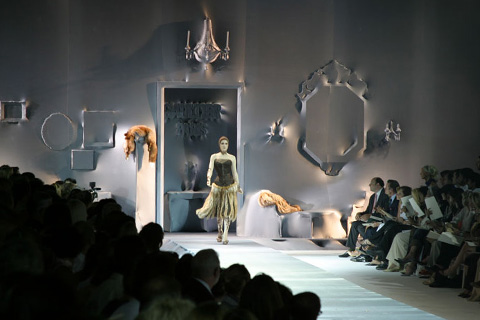
Studio Makkink & Bey will provide part of the interior design for the forthcoming retrospective exhibition in Paris of the work of the fashion designer Jean Paul Gaultier. The exhibition will be on view from 1 April to 3 August at the Grand Palais. Studio Makkink & Bey’s installation, Morphing: The Living, is inspired by the duo’s set design for Gaultier’s spring/summer 2004 fashion show.
The interior will be based around the Kokon Furniture series, designed by Jurgen Bey in the late 1990s/early 2000s. Gaultier noticed the Kokon range at the Sketch gallery in London and was so impressed that he asked Studio Makkink & Bey to design a set for his show. In the design for that show chairs and tables were pressed against an elastic skin, showing a skeleton of recognizable furniture forms. The backdrop connected arm rests and chair seats and merged into a domestic hybrid with the wall behind the fashion models. Now, in 2015, Gaultier has again approached the designers, who will transform the entrance room of the Grand Palais with Morphing.
Grand Palais, 3 Avenue du Général Eisenhower, Paris
Wednesday 1 April – Sunday 2 August 2015
Exhibition Jean Paul Gaultier 2015
Design Studio Makkink & Bey for Fashion Show Jean Paul Gaultier 2004
The Netherlands Built in Brick
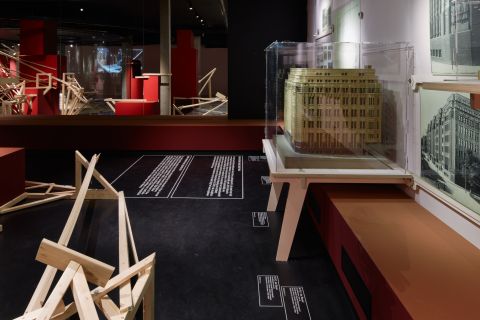
Studio Makkink & Bey have created the spatial design for the Surprising Finds series of archive exhibitions at Het Nieuwe Instituut. For each instalment, Studio Makkink & Bey carries out a spatial intervention in the institute’s OMA-designed interior, freeing up the plan of the archive room and creating space for the collection, and curates guest interventions by young designers and artists such as Leon de Bruijne, Govert Flint and Harm Rensink.
Het Nieuwe Instituut, Museumpark 25, Rotterdam, the Netherlands
Through Sunday 5 April 2015
The Netherlands Built in Brick website
Video of the project during the opening
Interior design De Rotterdam

Together with team members GROUP A and Roukens + Van Gils, Studio Makkink & Bey designed the interior of De Rotterdam, a design by OMA which is located next to the iconic Erasmus bridge in Rotterdam.
The design aim was reinstating the infrastructure of movement to prompt interaction between people of all offices present and facilitate meeting spaces so that they upgrade the time spent waiting to a more useful pause. Because the floor plan of this center space is identical on every floor, our design cuts through this uniformity so that each corner of the building is furnished for public use on all floors combined. Each part of the day, the public area on one of the building levels is sunlit, while the windows of the public spaces on the different floors together provide a 360 degree view over the city. The shared spaces with a grandstand that provides a great view for thinking, work sofa's and service area's that instill the convergence of ideas.
Reopening theater Kunstmin

Schouwburg Kunstmin is part of Dutch heritage and is of great cultural and historical value. As one of the last remaining buildings of architect Sybold Van Ravesteyn, the theater is deserving of an interior that pays a tribute to his neo architecture. Our interior design matches up to the elegant space like a well-fitting suit. To quote a newspaper in 1887: a theater should be the equivalent of a woman in full dress. Soft colors and materials and repetition of shapes and colors give the foyers a calm, but smart appearance.
Interior design Hôtel Dupanloup
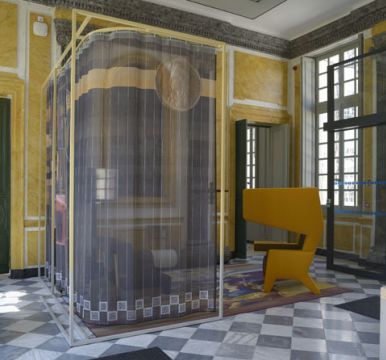
Once the home of a notorious bishop, the seventeenth century building in the town of Orléans, Hôtel Dupanloup, has recently been reconstructed to function as International Research Center of the University of Orléans. Studio Makkink & Bey developed a series of spatial installations that transform the historic Hôtel chambers into lively public spaces.
Invited by the The French Artistic Nationale Commission Makkink & Bey furnished the main room as well as 23 working/meeting rooms of Hôtel Dupanloup by creating eclectic three dimensional collages of furniture; amongst others PROOFF Worksofa's, EarChairs and SideSeats in new colourschemes, a 'Dupanloup chair- and table' specially designed for the project, antique pieces of furniture, a special edition of the Tree trunk Bench and re-designs made of Ikea furniture by students of École Supérieure d’Art et de design d’Orléans that participated in a summer workshop with Studio Makkink & Bey.
Carpets and curtains outline the reprogrammed spaces and introduce a new heraldy that narrates about the content of the local archives (such as from the local Fine Art Museum, the Frac Centre and the House of Jeanne d’Arc). The spirits of the past and present are merged and create rich contexts for researchers -and visitors of the International Research Center of the University of Orléans to meet- and work in. Even when not in use these 'room in a room' interiors are intriguing spatial still lifes that portray several layers of time, or as Director of Cultural Affair of the Centre Region Sylvie Le Clech describes them; 'A treasure hunt across centuries'.
The project will be finalized in September 2014 with the opening of the building and launch of a publication about the project development en renovation.
click here to go to the project page
Straight through the archive - Spatial interventions for Het Nieuwe Instituut
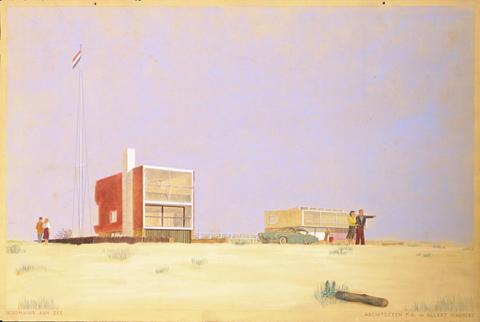
Straight through the archive, spatial interventions by Studio Makkink & Bey
in exhibition series 'Surprising finds from the collection' at Het Nieuwe Instituut, Rotterdam, The Netherlands.
Het Nieuwe Instituut will showcase a series of three presentations, titled 'Suprising finds from the collection', in which associative stories from their architecture archives are presented. From the wealth of drawings, photos and scale models the current- and first exhibition, 'Summer Dreams', is curated by Alfred
Marks. Studio Makkink & Bey positions the archive material in an active- and contemporary context throughout the trilogy of exhibitions.
With each exhibition in the series Studio Makkink & Bey creates a spatial intervention and curates monthly guest interventions by young designers, artists and architects. The interior interventions in the former OMA interior arise by treating existing elements as modular parts. The static space becomes a dynamic landscape which creates a floor plan that is flexible and allows for a more free way of using space for installing the archive collection and guest interventions. An interior that bends with the exhibitionseasons, showing signs of a constant state of moving.
Every month Studio Makkink & Bey invites a young designer, artist and architect to create an intervention that relates to the exhibition theme and its context. By doing so a new generation merges with the archive. During the current Summer Dreams exhibition designer Rogier Arents will create a colour range grid coming from his onsite felt tip printer in July. In August artist Zoro Feigl will transform the hanging ring in the space into a moving architectonic sculpture.
Surprising finds from the collection 1/3 : exhibition Summer Dreams
08 July - 21 September 2014
Het Nieuwe Instituut
Living Spaces exhibition extended
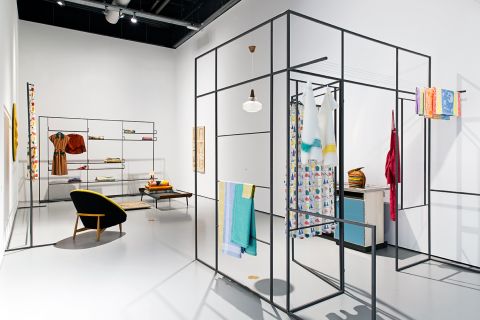
Studio Makkink & Bey is one of few design firms who combine curatorship and design. One of the exhibitions they curated as well as designed is the exhibition Living Spaces in the Textile Museum in Tilburg. Due to its success it was extended until June 1st. On show are abstract Dutch style rooms that provide a fascinating look at the changes in the use of textiles in the Dutch interior over the years. The period of Dutch Art Nouveau, Modernism in the 30s, the post-war period, the 70s, postmodernism and the recent period of Dutch Design for the concept room of the future: household goods. Studio Makkink & Bey designed a new collection for this concept room entitled 'Window Light', 'The Fold Site' and 'Heat Tissues'.
Cheese Maker, the sum of design, craft en education

Design, education and craft from the Netherlands and India merge together in the Cheese Maker, a design by Studio Makkink & Bey that was made for Imperfect Design. It was successfully presented at the 2014 Milan Design Week. The Cheese Maker is a literal stack of - handmade - parts needed to make Indian cheese (paneer), such as a milk jug, a cutting board and a cheese cloth. But even more, the object is a visible result of what happens when Dutch designers collaborate with local artisans in India.
The themes of knowledge transfer, development and education form an important thread in this project. Studio Makkink & Bey worked with a local trade school in Jaipur where crafts have a central role for the development of the Cheese Maker. Jurgen Bey: "In the Netherlands we see craft gradually disappear, whereas in India it is still part of basic education." Cooperation with craft groups in India offers opportunities to contribute to knowledge and education.
Exhibition The 7 Sins highly acclaimed
Dutch newspaper De Volkskrant appreciated the exhibition The 7 Sins recently with as much as 4 stars, and it has been widely acclaimed by the international media. The last opportunity to see this exhibition is in May 2014.
In the exhibition The Seven Sins, Studio Makkink & Bey takes the famous painting by Hieronymus Bosch bearing the same name, as a starting point and makes connections between art, design and everyday objects from the past and present. In seven scenes, mostly interiors, Bosch depicts what behavior these sins lead to and how they are reflected in the the sinners' surroundings. In Studio Makkink & Bey's view inner motives of people can be read in their surroundings and interior. In this respect vices lead to activity and creativity rather than virtuousness.
SUPERMODELS Doll House showing a mini KadE and KOKON Chair
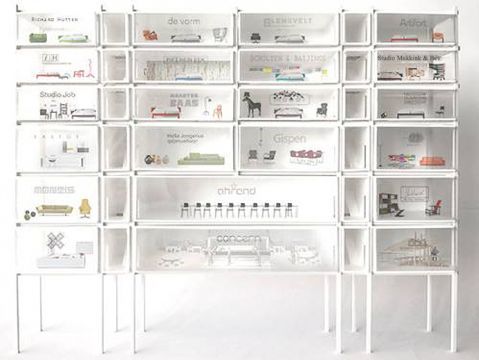
'SUPERMODELS' shows scale models of our KadE Chair #01 and KOKON Double chair at its first stop: Salone del Mobile 2014 in Milan. The travelling exhibition about product design, architecture and interior architecture was initiated by the designers of Concern. Inside a doll house a compilation of Dutch design through the centuries is presented as 3D printed scale models by 3D WORKNET. Read more here or visit the doll house at Salone del Mobile from 7-14 April 2014), Via Ventura 5, Ventura Lambrate, Milano.
Interior for residence in Belgium
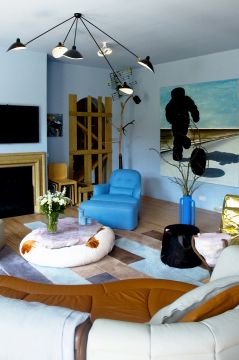
Studio Makkink & Bey has completed the design of a home of one of our clients. Bright colors and bespoke furniture and furnishings fit the wonderful art collection and set the design apart.
Want to Work at Home in Z33 Hasselt Belgium?

1st of december 2013 until March 30 2014
Would you like to try out the Work at Home #3 module by Studio Makkink & Bey in the exhibition Atelier à Habiter yourself? Be sure to make reservations here. The new versions of Work at Home and Lost in Translation are shown in Z33 as part of the exhibition Atelier à Habiter. This is an experiment through which artists, architects and designers aim to rethink and redefine the concept of ‘dwelling’. Z33 shows a wide range of proposals for accommodations that are well equipped for the demographic, social, environmental and economic conditions which continue to fluctuate rapidly. To expand on the theme of nomadic dwelling, the work dormer is now portable and foldable too. Upon entering Z33 you'll see the wooden work unit sitting on the entrance stairs. At Z33, creative professionals take on a role as a planner, organizer and designer in an 'atelier à habiter' or dwelling workshop.
Photography: Kristof Vrancken
V&A Museum London acquires Ear Chairs
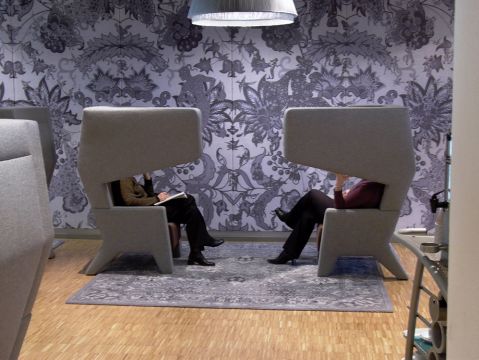
The Design Fund to Benefit the V&A, established by Yana Peel, enabled the museum to acquire five contemporary design projects for their permanent collection. Martin Roth, Director of the V&A, regards the Ear Chair to be "one of the best and most exciting design projects of our time". The V&A deems the chairs to significantly enhance their holding of contemporary design, a collection which reflects what is new, influential, innovative or experimental, and what is representative of current trends in design and society. The annual selection of acquisitions is displayed for the first time during London Design Festival. This year's pieces will be on display in the V&A's New Acquisitions Gallery, Room 19a. Read more.
Exhibition The Tyranny of Objects

Exhibition from October 16th 2013 until January 4th 2014. Galerie des Galeries exhibition venue on the first floor of Galeries Lafayette in Paris.
The Vacuum Cleaner Chair is exhibited in 'La Tyrannie des Objects' curated by Alexandra Fau. The objects in the exhibition were handpicked by her to encourage visitors to see daily objects in a different light. Their common features were tweaked in such a way that the objects emphasize, or comment on their relationship with us. In case of the Vacuum Cleaner Chair (part of the Dust Furniture series) dust is turned into an essential part of the household. Instead of removing dust, the vacuum cleaner collects it to give mass to the dust bag furniture.
Work at Home at SELF UNSELF
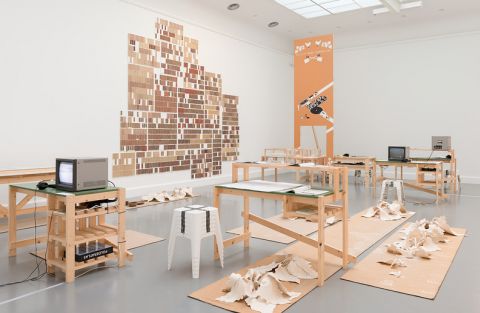
Design Academy Eindhoven: guest at the museum from 19th of October 2013 until November 7th 2013.
Foodprint Erasmusveld Utility Associations, Silver Sugar Spoon and part of INDUSTRIOUS|artefacts are on show at the Van Abbemuseum during SELF UNSELF. Following this year's Design Academy Graduation Show theme; 'Self Unself', the Van Abbemuseum is showing works that explore the tensions between ‘I’ and ‘we’ in contemporary design. the exhibition centrals around the role of the individual in the work of the latest generation of designers and how they value the collective.
Work at Home at the Klokgebouw during DDW
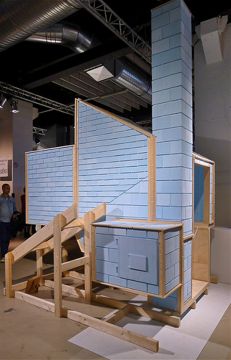
Work at Home is presented by Organisation in Design at the Klokgebouw during the Dutch Design Week. The dormer is an extended roof and window serves as a basis for a hybrid work unit, a. Inside, it has a desk, shelving and even a small heater and chimney, and a large window overlooking the surroundings.
Photography: Klaas Vermaas
Exhibition: The Seven Sins
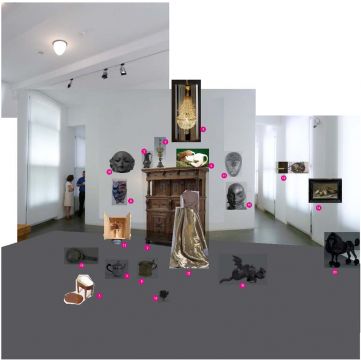
Exhibition from September 14th 2013 to May 18th 2014. Commissioned by Centraal Museum Utrecht.
The 15ht century painting 'The Seven Deadly Sins and the Four Last Things' by Hieronymus Bosch serves as the starting point for Studio Makkink & Bey's 7 sins exhibition in the Centraal Museum in Utrecht.
In the painting the sins are shown in scenes from everyday life. The objects in the exhibition parallel the ones in the painting to dissociate them from their usual frame of reference, so different connections amongst them can be imagined. This way, the pieces from the museum's collection, works by Studio Makkink & Bey and by other contemporary designers and artists might establish some thread from the world then to the world we're in now. Visitors can see unanticipated connections amongst the fashion, art, applied art, urban history and discover the narrative power objects can have.
The Centraal Museum also says goodbye to its parting curator and deputy director Ida van Zijl at the opening of the exhibition on Sunday the 15th of September. Please send an e-mail to rsvp@centraalmuseum.nl if you'd like to join us there.
Werkstadt Vienna at The New Institute's The Ruin
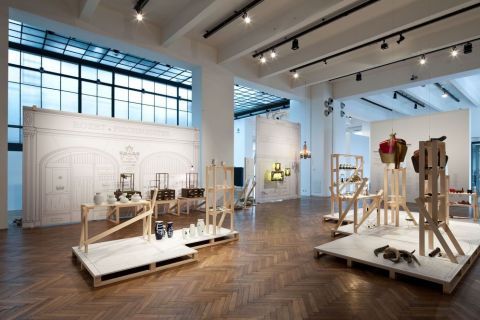
June 22nd until September 15th 2013
The exhibition shows parts of recent exhibitions by sister organizations, each of which touches on an aspect of the future agenda of The New Institute (formerly known as NAi) in Rotterdam.
Werkstadt Vienna shows what happens when young designers are coupled with traditional manufacturers, and how important local and regional production methods are as an engine of innovation. Werkstadt Vienna is an exhibition of the Vienna Design Week in collaboration with MAK – Museum of Applied Arts/ Contemporary Art in Vienna. Curators: Sophie Lovell, Studio Makkink & Bey.
Starting Something - during Beijing Design Week 2013

From 26th of September to the 3rd of October 2013.
Starting Something is curated by studio maarten kolk & guus kusters and Jurgen Bey and is initiated by of the city of Amsterdam, as part of their guest city program during the Beijing Design Week 2013. The project aims to exchange views about art and design, to share experiences and knowledge and to learn from each others work methods, approaches and industries. Students of The Central Academy of Fine Arts in Beijing and 30 designers from the Netherlands participate in workshops, lectures and food interventions and Starting Something exhibition.
Sandberg Masters 2013
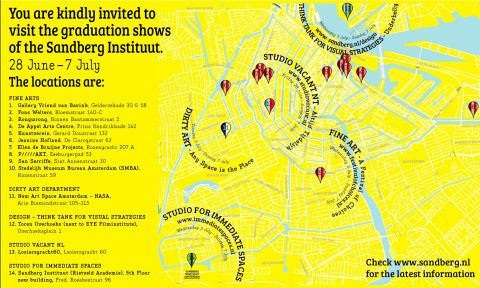
Sandberg director Jurgen Bey congratulates all graduates of The Sandberg departments who've exhibited their graduation shows throughout Amsterdam (from July 3rd to 7th 2013). For more info please visit the Sandberg website.
Vacant NL was the first of all departments to open their graduation exhibition Always Temporary, on Friday 28th. It runs until July 7th, 11 am. - 7 pm at the Contemporary Art Lab at Looiersgracht 60.
Next up: Design - Think Tank for Visual Strategies opens Friday July 5th between 6-8 pm at Toren Overhoeks, Overhoeksplein 1. Exhibition July 5 - 7th, daily between 12 - 8 pm.
Fine Arts - Festival of Choices at various galleries in Amsterdam. Opens after diploma ceremony at Paleis van de Weemoed, Oudezijds Voorburgwal 15. Exhibitions July 5 - 7th, some longer. Please check the the gallery schedule.
Dirty Art Department opens with Any Space is the Space, at NASA on July 2nd, 6 - midnight. Exhibition July 3 - 7th.
Studio For Immediate Spaces opens on July 3, 6 - 9 pm. Exhibition July 3 - 7th at Sandberg's homebase: Frederik Roeskestraat 96, floor 5. Please the site check for exact dates.
3 pavilions in the Natura Docet landscape garden

Provincial Museum of Natural History Natura Docet, Wonderryck landscape garden. Open from June 7th 2013
Design of three wooden pavilions in the new Wonderryck landscape garden, next to the Provincial Museum of Natural History Natura Docet in the eastern part of the Netherlands. While the museum building was renovated by SeARCH, LOLA architects laid the basis for the overall park design and redesigned the garden. Each framework has its own significance in enhancing a certain wildlife experience as a bees hotel, a living bridge or an 'indoor' biotope.
The 'indoor biotope' stands on a roundabout and has the form of a house for humans, but is in fact intended for animals and plants only, humans are kept out with beams that block the doorway. The house on the prairie is furnished with a mix of grasses, shrubs and a fruit tree attracting insects, birds and other small animals that are protected by the road around it. The living bridge across the water with built-in benches, soon to be completely overgrown with wild Clematis to hide the people inside, is also an observatory and study cabin. Local beekeepers took residence in their new bee tower that references the industrial salt towers known to the area. The platform on top can be reached with a ladder and provides an outlook as well as a possibility to move the hive body high up on the platform, where bees feel at ease. Read more...
PROOFFlab presents new ideas at Salone del Mobile Milan
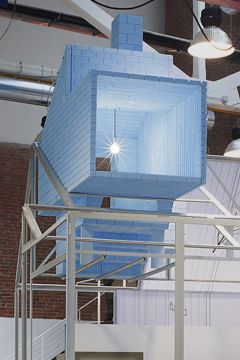
9th – 14 th April 2013 | Emporio building in Opificio Courtyard | Via Tortona 31, Milan
During the Salone del Mobile 2013 in Milan a PROOFFlab will present work in progress that centrals around the theme of acoustics. Studio Makkink & Bey asked Belgian collective jij's, a spin-off from architects de vylder, vinck, tailleu, and Studio Maarten Kolk & Guus Kusters to work in tandem on the acoustics theme. Architects dvvt's design of a modular cabinet is based on changing space and sound with an acoustic wall unit that can serve as a divider of space. In the end, costumers purchase a blue print, the architect's drawing hours and the cabinet maker's hours. The Cloud Boxes in three sizes by Maarten Kolk & Guus Kusters, box in space for hiding and concentration, or it diffuses the light of a lamp that is placed inside. Studio Makkink & Bey has designed a movable work unit: 'Work At Home' can be appended to the rooftop of a house and removed when is no longer wanted. The prototype is a blue foam dormer that doubles as a desk with a shelf and even a small heater and chimney. While it can be delivered at your doorstep, construction and installing shouldn't be any harder than installing a dormer. Please find more information on PROOFFlab's new blog.
Shop Window for Hermès Japon
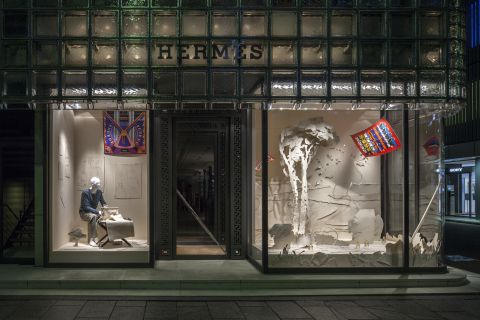
January 24 – March 19, 2013
Maison Hermès asked Studio Makkink & Bey to design a window display with a sports theme. A Soft Gust Of Wind merges softness, kite flying and the act of making to connect with the skillfully made fashion of Hermès. It features kites, whirlwinds, woolen felt, a landscape in threads, a Japanese master and a mastermind sewing an imaginary universe.
i.c.w. Anke Weiss
Tokyo: Fantasy Room For Working

Hikarie 8/ aiiima, Shibuya, Hikarie, Tokyo - February 19th until March 3rd 2013
On show in the Creative Lounge in Tokyo Japan: Earchairs, Worksofa's, one SideSeat, one KadE Chair and a Vacuum Cleaner Chair, stools and aprons - and our founder Jurgen Bey. He will work in the Aiiima space behind the exhibition in a big shared office space. Wi-Fi, smartphones, working 24/7 everywhere in worldwide networks doesn’t mean we don’t need offices. What should office spaces look like? The social designers of Studio Makkink & Bey continue to explore the idea of a Progressive Office in a series of furniture.
Between the 18th and 25th of February, Jurgen Bey will take office here, to meet with potential clients. Are you aspiring to make use of the design skills of Studio Makkink & Bey? Make sure you visit Aiiima during Jurgen Bey's stay.
PROOFF Stand in permanent collection Centraal Museum Utrecht

The Centraal Museum has acquired the ‘Prooff Stand working and living landscape’ and is displaying part of it in Expo 3. Several pieces are exhibited on a rack shelving system together with the PROOFF floor boards that form a unity with the wall panels. The items on display include the SlowCar, the EarChair and the newly designed SideSeat together with several of our WorkSofa's, the electric WorkTable and the Social Sculpture. The floor and wall panels show the worklandscape as envisioned by Studio Makkink & Bey. The exhibition runs until May 25ht 2014. Please visit the Centraal Museum's website to plan a visit.
Imperfect Design by Studio Makkink & Bey
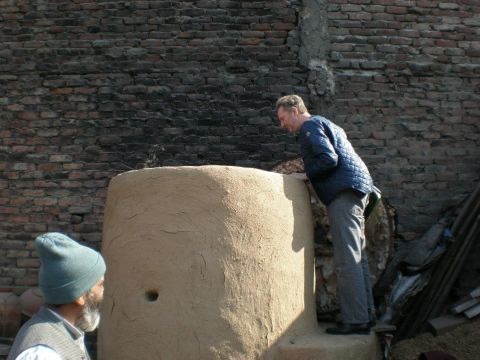
At the invitation of Dutch DFA Jurgen Bey and Rianne Makkink, traveled together with Monique Thoonen (Imperfect Design), Lonny of Rijswyck, Jan Taminiau, Joost Grootens and Simon Davies to Mumbai in India.
The objective of this journey was to focus on design and local crafts and to strengthen the international position of the Dutch creative industry by promoting long-term international relationships. Jurgen Bey and Rianne Makkink continued their way to India and travelled further from Delhi to Agra, Rajasthan and Mumbai to visit various craft collectives. Follow the project on Facebook.
Werkstadt Vienna, Design Engaging the City
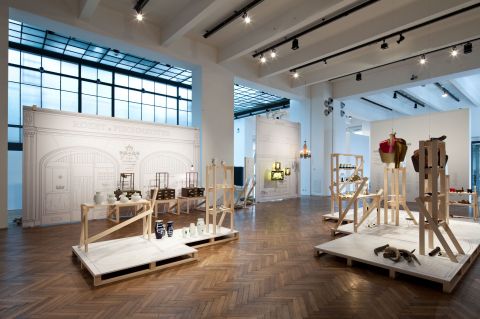
Commissioned by MAK Vienna. Exhibition from 12th of December 2012 to 17th of March 2013.
The Passionswege exhibition shows local production workshops based on a 19th century tradition of passionate cooperation between the Viennese applied arts industry. Read more here and here.
MAK Exhibition hall, MAK – Austrian Museum of Applied Arts / Contemporary Art, Stubenring 5, Vienna
Curator: Thomas Geisler and Guest Curator: Sophie Lovell, design: Studio Makkink & Bey.
SideSeat on tour

The SideSeat is the latest addition to a portfolio of products and is available at Prooff. It is a self-contained desk, cupboard and chair which moves with you and it was presented at Super Brands London and Orgatec Cologne.
Interior design De Rotterdam
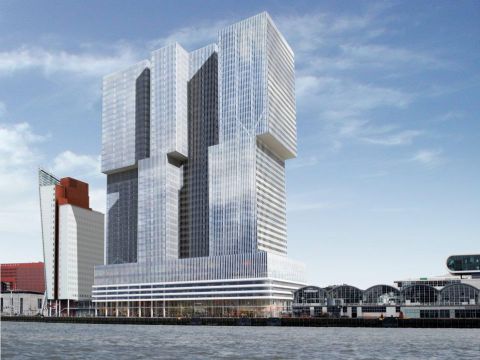
Together with team members GROUP A and Roukens + Van Gils, Studio Makkink & Bey has been selected for a two staged European tender to design the interior of De Rotterdam which is located next to the iconic Erasmus bridge. De Rotterdam was designed by OMA and is conceived as a vertical city: three interconnected mixed-use towers accommodating offices, apartments, a hotel, conference facilities, gym, shops, restaurants, and cafes. The aim is to reinstate the vibrant urban activity of trade, transport, leisure that was once familiar to the neighborhood. Rotterdams' municipal offices will occupy the 33 floors of the middle tower out of three. The designers envisage an interior that reflects a 'vertical city' linking 'urban hubs' for collective use, meeting and interaction and will be completed in the course of 2014.
Exhibition design INTERIEUR Kortrijk 2012

Part of Future Primitives. 20 - 28 October 2012, Kortrijk Belgium.
The exhibition design 'Lost In Translation' shows industrial materials that become the frame of a house, and self-build becomes the norm. Domesticity is detached from brick and mortar or the value of a mortgage, but now deals with the social relations between members of temporary groups and nomadic aspects of mobility. The projectroom showed one minute films with scenes that display how changed parameters have a strong influence on the way we live.
What if 'on the way' no longer exists, but on the way is a place itself? We'd always be staying somewhere now. We might get lost in translation while living privately in public, our carefully designed infrastructure then would become our living. In this future primitive, how would we dwell, what would we store? We work while blurred landscapes pass by, we sleep at 12000 meters during a flight and the attic has moved into big yellow self-storage boxes along the highway. Home is where the heart is. Please find more information on Dezeen and here.
One night in Buijtenbed: a polder cabin
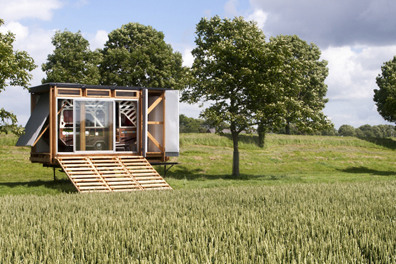
It was possible on Saturday 6 and Sunday, October 7 2012 during 'Food on the levee' in Barendrecht.
The mini festival on the farm at the Noldijk in Barendrecht included 3 tools of Werkplaats Buijtenland. Cook / designer Lucas Mullié was cooking in the Buijten/Outside Kitchen by Elmo Vermijs while Buijten/Outside Brewery by Henriette Waal produced apple juice and cider. Stunning views over the land could be seen during a stay in Buijten/Outside Bed by Studio Makkink & Bey.
Photography: Ralph Kämena
Mapping Flevoland

A summer event organized by Museum De Paviljoens to present the Summer School projects in collaboration with the Amsterdam Academy of Architecture. In the period 2009-2012 students of the academy investigated the cultural identity of Flevoland and the Noordoostpolder.
Summer School 2012

During a Summer School session on August 22nd - 30th 2012, we made a new kind of production landscape 1:1, based on a three themes: compost, water and energy. While working in groups, we set up three utility associations: the Association of Clean Water & Energiepath & Compost. These are based on, existing industrial utilities such as water, electricity and waste companies.
This idea stems from Utility Associations Erasmusveld, an earlier project that was realized in cooperation with Stroom The Hague. With these utility associations we wanted to propose a shared responsibility for the development of the area and reverse the process of how a district is usually designed. Students were invited to work as pioneers and react on the typical Dutch polder environment of the Noordoostpolder. The students could stay in very unusual mobile accommodations in Kraggenburg such as a kingcab, a caravan, alpenkreuzer and woodsheds that were especially designed to accommodate Noordoostpolder explorers.
The results of the summer school were part of the exhibition Mapping Flevoland on 15 and 16 September 2012.
Utrecht Manifest NO. 4: A Working Landscape
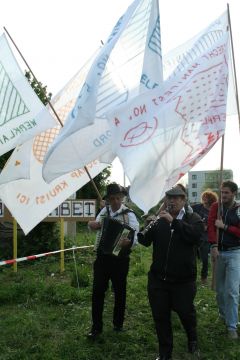
On May 1st, former mayor of Utrecht Annie Brouwer-Korf, initiator Harm Scheltens and art director Jurgen Bey opened Utrecht Manifest NO. 4, followed by a speech by journalist and author Tracy Metz. A parade took us past the exhibition spaces: an empty lot and the Rotsoord workspace, where flags were spray painted by Hektor..and Utrecht Manifest NO. 4 was officially open to the public.
Through various viewpoints, this years' biennial for social design examined worklandscapes in the urban area of Rotsoord. A taste of Rotsoord's potential for food production is found in Edible Landscape. The Networked Landscape examined cross-pollinations of knowledge and skills. Clever and inventive ways of production were exhibited in the exhibition Helpdesk Rotsoord; which served as food for discourse. After tasting Rotsoord beer and pesto, parades, lectures and Drive-thru-debates, working with designers, local experts, residents and businesses, the biennial has ended.
Visit Utrecht Manifest NO. 4 in the virtual tour on our website. Or, for more information, please check: utrechtmanifest.nl. Utrecht manifest is working on a publication about the biennial, which is to be released soon.
Education Trestles and Easels was shortlisted for the Frame Moooi Award 2012
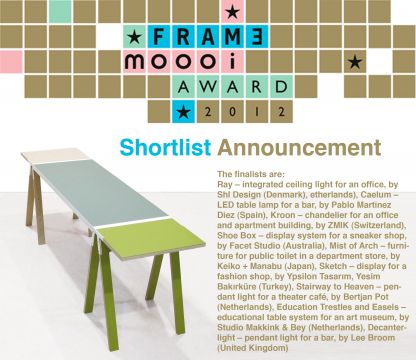
Designer Philippe Starck, handpicked the top 10 finalists of the Frame Moooi Award 2012. Congratulations Bertjan Pot!
Milaan Mini-symposium Never Mind the Mainstream - Experiment and Design
April 18th, 14.00 - 17.00 uur, Triennale Museum Milaan, Viale Emilio Alemagna 6
Jurgen Bey will speak at Never Mind the Mainstream together with Aaron Betsky, Anne Mieke Eggenkamp, Konstantin Grcic, Rogier van der Heide, Hella Jongerius, Pieter Kool, Julia Lohmann and Petra Schmidt. They will talk about experiment and research in the historical and contemporary design industry/production in Germany and the Netherlands.
Camper shoe shop in Lyon: a store concept
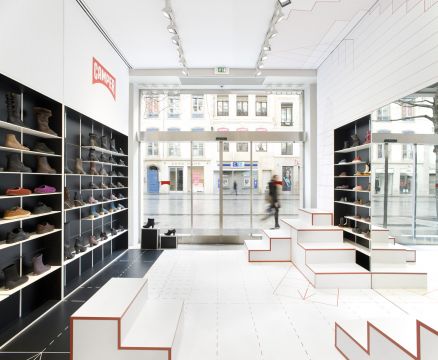
The design for a new store concept for a Camper shoe shop in Lyon, is grounded in basic walking movements. Movements forward, upward and downward are shaped in staircase pedestals, stools or stepladders and outlined in bright red lines on the stairs, wall and floor. Stairs represent the conjunction of separate places. While performing as a place to meet, sit on or pass through, they expand places and establish rhythm, depth and infinity of spaces.
Open for public in May: Utrecht Manifest Helpdesk
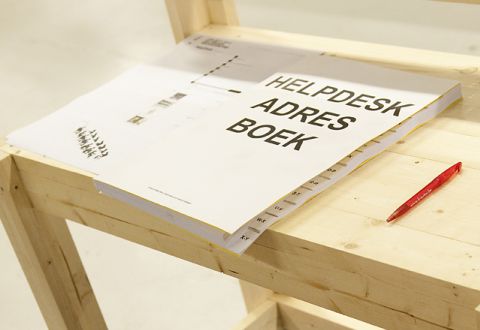
How do you expose the potential of a specific site? The urban area Rotsoord, in the Dutch city of Utrecht, was transformed into a work space between May and July 2012 under the art direction of Jurgen Bey. Utrecht Manifest edition 4 settled in the former industrial site of Rotsoord to investigate it under the main theme of A Working Landscape through four main projects. A Working Landscape is a development model to help convert Rotsoord into a gateway to the inner city. Curators programmed exhibitions, debates, a help desk, workshops and field projects to activate this process.
A Working Landscape - 4 projects: Studio Makkink & Bey asked Studio Maarten Kolk & Guus Kusters to open a 'Helpdesk Rotsoord' for the area's residents and curate an exhibition about production processes. In 'The Networked Landscape' Sophie Krier investigated available knowledge and skills. Ester van de Wiel explored the possibilities for food production and processing in the city to turn these into working tools in her project: 'Edible Landscape'. 'The Broader Landscape' performed as a public platform for the analysis of the potential of the urban landscape as a living, learning and working domain. Read more and find out about our activities here.
Watch the video of Symposium Me Craft/You Industry
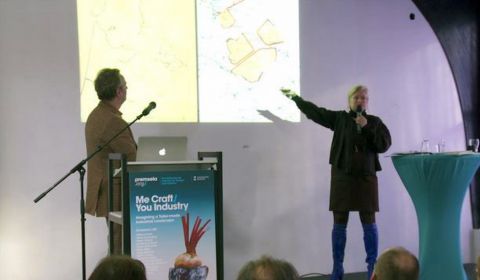
Video: Rianne Makkink and Jurgen bey speak at the symposium Me Craft/You Industry. Makkink describes the consequences of changing the Zuiderzee landscape. These weren't just the radically different vista and the smell of saltwater that made way for solid clay, crafts and their organizational forms shifted completely. Fishermen were to produce all kinds of food as farmers, fingers operated buttons instead of knitting fishing nets. Along with this came a change of tools. Chained specialized handwork turned into industrial machine production and not simply to make everything quick and easy. Jurgen Bey continues: 'If this were true, we'd soon invent a button to make life pass swiftly without any effort.' We make our world in likeness of society. Where in the nineties design was driven by handwork and crafts as a way of small scale making, now, in our computerized world, the focus lies on the process and causes design to shift toward the machine. Shrinking manufacturing allows production to move back into our cities, next to one-man factories such as the shoemaker and locksmith that are already there. What will happen if production is again, more physically ingrained in our daily lives?
To watch Smári McCarthy, Henk Oosterling, Pieter Tordoir and designers Dries Verbruggen (Unfold), Hanna-Lisette Wiesener (Trikoton) and Kieren Jones speak, go here.
Dutch Design Workspace for Dutchdfa in Mumbai
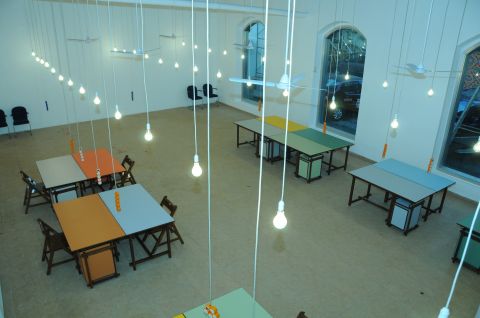
Architects, designers and other entrepreneurs from the creative sector with plans to set up shop in India, can hire a workplace here including the use of meeting rooms. The Workspace in Lowel Parel, a central district which is growing out to be the creative hotspot of Mumbai. The interior is a mix of Dutch and Indian styles and is designed by Studio Makkink & Bey. Workstations form part of a fully-equipped shared office space and can be rented for short and long term use. Dutch designers setting up in India will receive business support that has been specifically tailored to the local context. A permanent feature of the Workspace is a design desk for hosting matchmaking activities between Dutch and Indian design companies. Read more here.
'Vacant NL, where architecture meets ideas' winner of the 2011 Rotterdam Design Prize
Vacant NL challenges the government to hand over keys instead of money so that, while vacant, buildings can serve as places where connections and cross-pollinations can arise that will catalyse future plans. As a statement, Rietveld Landscape's Vacant NL is saying, 'Right time, right place – let’s go!'. We hope that policy makers will recognize the potential of space as a currency, when money is running short to subsidize progress. Read more here.
Jurgen Bey ambassador of The Green Design Competition

The selected 40 participants submit their perfected proposals for round 2 before April 6th 2012.
Participants in this contest are challenged to design a product and write a business plan, that contributes to sustaining biodiversity, either in concept, design and production, or usage.
The Green Design Competition is initiated by Dutch Design Week and the Ministry of Economic Affairs, Agriculture and Innovation. Entries are now closed.
For information please visit: www.thegreendesigncompetition.com
The Free-range Shelter: an innovative free stall dairy farm

Commissioned by the Province of Utrecht, i.c.w. LaMi, CBKU and Henk den Hartog.
Upscaling without expansion, the well-being of cows and the versatile farmer are all integrated in the design of an innovative dairy farm. The organic dairy farm of Henk and Wilma den Hartog Abcoude, is shaped by double use and stacking spatial features in a cost-effective building plan. The shape of the energy neutral farm is based on the roof of average farms, but it remains unfinished and open for the free grazing dairy cows. Originally a forest animal, the cow can find shelter underneath the partially canopied pasture. At the same time, this canopy is the modular home and work complex that accommodates all the activities of a modern farmer. In the course of time, recreational and educational tasks were added to the farming profession. This is why the hovering farmhouse is a roof, dairy farm, office, education space, temporary lodging and home in one. Studio Makkink & Bey started to experiment with upscaling. This soon led to a number of proposals which weren't introverted and inward, like the current freestalls, but have an outward view. The result: a Free-range Shelter with the possibility to expand to a Free-range Farm. Read more here.
‘Vacant NL, Where Architecture Meets Ideas' wins Dutch Design Awards

Vacant NL calls on the Dutch government to utilize the vast amount of vacant properties in The Netherlands for creative enterprise, networks and innovation. The Dutch exhibit for the International Architecture Biennale of Venice 2010, was curated by Rietveld Landscape. Vacant NL was a team effort by: Jurgen Bey, Joost Grootens, Ronald Rietveld, Erik Rietveld, Saskia van Stein, Barbara Visser and Claus Wiersma, who visualized the potential of vacancy in their installation of blue, floating buildings with different typologies. Because of Jurgen Bey's part in this project and being director of the Sandberg Institute, the Venice project spawned a new, two-year masters program called Vacant NL at the Sandberg Institute. Together with teachers Barbara Visser, Ester van de Wiel, soon Frank Havermans and 9 students, heads of department Erik and Ronald Rietveld work on proposals for unoccupied spaces to create ideal conditions for app developers.
Foodprint Utility Associations Erasmusveld
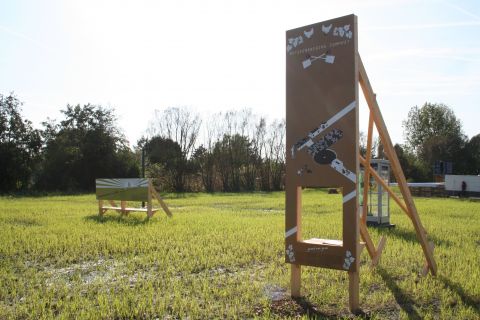
Commisioned by Stroom Den Haag. Exhibition from 30th September to 16th October.
Erasmusveld is an urban development area in The Hague that is set out to become a highly sustainable and self-sufficient neighborhood. Studio Makkink & Bey was asked by Stroom to introduce a design strategy that performs as an incentive for sustainability in Erasmusveld.
Instead of drawing a layout of streets, we started with a social structure and tried to form a community. Together with future inhabitants, local clubs, companies, the local government, policy makers and other parties who are involved with the developments in the area, we founded pioneering Utility Associations. Solid bonds can help support the sharing of responsibilities and caring for shared space. The theme of each association corresponds with existing public utilities such as: the water company, energy suppliers and the waste company.
In the 'Clean Water Association' members help to clean rain water for future households with purifying slugs and algae-eating fish. The bees on the asphalt strip of the Energy Path Association, improve the immune system of locals with their custom made honey who can also get their share ofpumpkin turnover, produced by the Compost Association. On the compost, people can harvest eggs and meat from a variety of free range chickens who live between the pumpkins that grow on the compost pile. Read more about the Utility Associations Erasmusveld here.
Studio Makkink & Bey was selected to design the interior of Theater Kunstmin in Dordrecht.
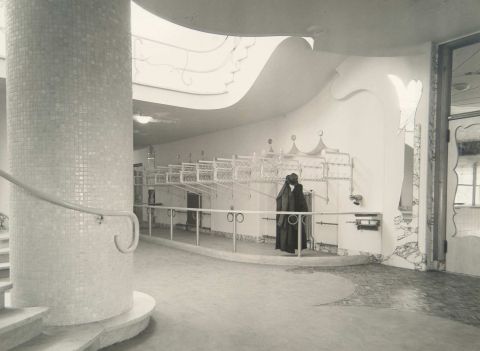
Schouwburg Kunstmin is part of Dutch heritage and is of great cultural and historical value. As one of the last remaining buildings of architect Sybold Van Ravesteyn, the theater is deserving of an interior that pays a tribute to his neo architecture. We're aiming to design an interior that matches up to the elegant space like a well-fitting suit. To quote a newspaper in 1887: a theater should be the equivalent of a woman in full dress.
The completion of the interior of Schouwburg Kunstmin in Dordrecht is expected in 2014.
The Crate Series on show at Design Miami/Basel by Spring Projects
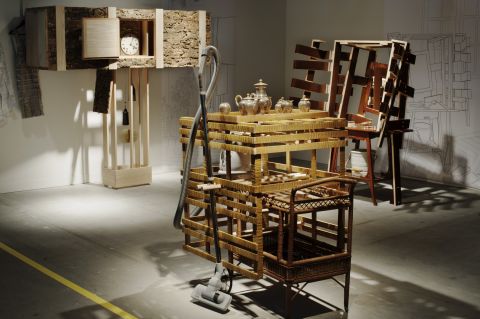
Tuesday, 14 June to Saturday 18 June
Daily from 11am-7pm.
Design Miami/ Basel takes place in Hall 5 of Messe Basel, a short walk from Halls 1 and 2, where Art 42 Basel is held.
The Crate Series: Household Crates
These shipping crates, normally used to temporarily house goods, take on a more solitary role as a sized down household unit. Each of the crates trade off space against utility. The various models encompass a specific function, concentrated inside the crate and in its material finish. In their original guise as freight packaging, the crate protects its contents, but as furniture they become a means of personal autonomy. Hiding and disguising are integral to these objects. The wooden retreats can be used to seclude a person from the outside world, but when unfolded they become furnishings inside an already furnished room. While travelling, they can form a familiar space within unknown spaces.
The Crate Series is an enquiry into the delineations in public and private time and space as well as the role of the objects we use within these spheres. Just as the function of a singular household appliance doesn't mark or dominate a room with its purpose of existence, so the bed hidden inside the BedCrate doesn't denote the room as a bedroom nor the bath and basin to a bathroom. This is a unifying theme of the series as the ClockCrate attempts to smother its own ticking sound and the VacuumCleanerCrate cleans up after serving tea from its built-in trolley.
Exhibition INDUSTRIOUS|artefacts opens May 26th 2011
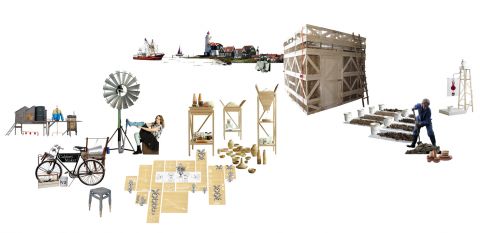
Studio Makkink & Bey and the Zuiderzee Museum in Enkhuizen present 'INDUSTRIOUS|artefacts', the evolution of crafts. The exhibition opens May 27, 2011 through February 12, 2012.
Guest curators Rianne Makkink and Jurgen Bey address the evolution of production processes and small industries through the work of Dutch and international designers.
Industrial developments are shown along the lines of the Zuiderzee history and extends itself to current representations of the production process. The work is grouped around three thematic sections: local resources, industrial processes and imaginative hybrid objects. This exhibition draws on the Museum’s historic collection complemented with inventive machines by young designers. This interaction between past and present-day expressions of design, illustrates how design affects every day life.
About the Zuiderzee Museum
The Zuiderzee Museum in Enkhuizen is oriented toward art, culture and heritage of the former Zuiderzee area and the IJsselmeer area. Communities, crafts and water play a central role in the Museum’s many exhibitions.
Zuiderzeemuseum Enkhuizen
3244 Worked All Europe

Studio Makkink & Bey was asked by Droog Design and designer Theo Theodorou to design tableware. Through a collaboration with talented graduates from art schools and the work of local artisans from various countries in Europe, we will create a European dinner set and build a creative network at the same time.
1 month, 160 hours in a train. Our designer Daphnée Lanternier is crossing borders through The Netherlands, Norway, Finland, Poland, Austria, The Czech Republic, Slovenia, Serbia and Turkey. On her travels, she visits talented craftspeople in 9 European countries. Each of the countries was chosen for a specific craft the country is famous for. So, Dutch ceramics, Scandinavian needlework, Polish amber, Bohemian glass, Vienese silver ware, Balkan wood, Turkish carpets are the incentives to create a mug, plate, table cloth, napkin, napkin ring, glass, carafe, candle holder, salt cellar, cuttlery, tea pot, tea cup, table, carpet, chair, bowl, spoon, trunk.
Dinners will be held in each of the countries visited by our studio. Dinner guests enjoy dinner together with Theo Theodorou and while using the table ware that was created.
To see Daphnee's journey, visit her blog: workedalleurope.blogspot.com
3243 Cabin Seat at Galleria Nilufar Milano
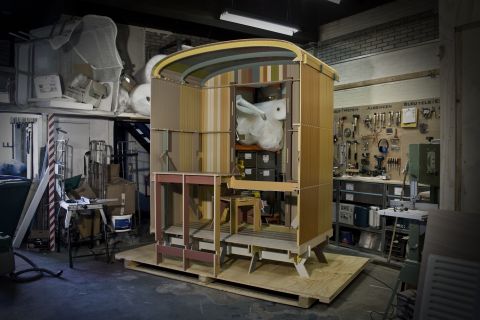
Nilufar presents on Monday, April 11th 2011: ATOMI
The Cabin Seat is a paneled worklandscape. An enclosed space for one person offering a possibility to retreat and create some privacy. Spacial functions shift from room to product in this open structure, which is a desk and a work space at the same time. The work questions the distinction between object and the notion of space. Wooden boards can be easily slotted into the construction. Flexibility, its' easy deconstruction and reconstruction are shown in the construction which is modular, but also references mobility. The cabin implicates model making and the colorful, evenly cut multiplex boards give the structure its playful traits. The open and versatile structure has the look of a spacial drawing and leaves enough room to interpret the work. The cabin recalls an actual space from the past; when the studio gathered in a construction workers’ trailer to have lunch and discuss projects.
The exhibition will run till the end of May, from Tuesday to Saturday, from 10.00 a.m. to 7.30 p.m,, Monday from 3 p.m till 7:30 p.m.
Galleria Nilufar 20121 Milano, 30|32 via della Spiga www.nilufar.com
3202 Slide-fence for the Reimerswaalhof courtyard
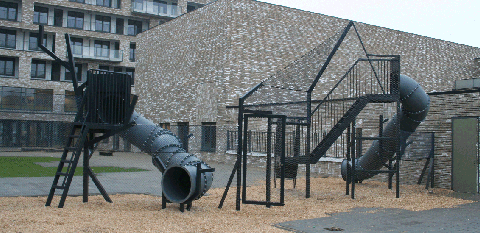
Slide-fence by Studio Makkink & Bey, commissioned by housing corporationYmere.
Location: Reimerswaalhof in Amsterdam New West, in the district of Osdorp. Opening on the 1st of March 2011.
Studio Makkink & Bey was asked to develop a concept to define the private spaces in the courtyards of Reimerswaal. Both the play sculpture, and courtyard fence are fused together - combining the private and public functions of street furniture. The buildings around the 'Reimerswaalhof' courtyard were designed by Mecanoo architects. The buildings include social housing, private sector housing, wheelchair accessible housing, apartments, an office space and an elementary school. Houses and additional facilities were designed to integrate public and private components through shared spaces.
The fence marks a transition between the private features that are typical for an enclosed yard and the public character of the space around it. The play sculpture by Studio Makkink & Bey was designed to invite the schoolchildren of Sint Lukas elementary school to share their domain with the children who live there. The children can easily slide back and forth over the borderline between private and public domain. By doing so, they playfully soften and smudge the boundaries of ownership.
Like the architecture of the surrounding buildings, the fences form a family together. Individually, the railings each maintain their own character and depict their own story, while the line drawings in steel rods create perspective and a spatial effect. Domestic elements were used to make the public space feel safe and comfortable.
Reimerswaalhof is the first of nine courts in the District Reimerswaal to have been realized and others will soon follow.
The slide-fence was made possible with financial support from the Amsterdam Art Fund, the Amsterdam New West District, Sint Lukas elementary school and housing corporation Ymere.
Exhibition Field Work Noordoostpolder
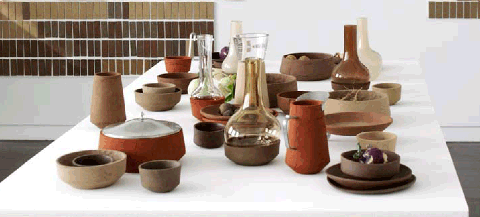
Exhibition from november 23th 2010 untill april 3rd 2011 in Nieuwland Museum Lelystad
Field Work Noordoostpolder is the result of a project by Maarten Kolk and Atelier NL (Nadine Sterk en Lonny van Rijswijck). The group was invited by Studio Makkink & Bey to work on a project for one year and dive into the history of the Noordoostpolder and the reclamation of land. The three designers, all graduates from the Design Academy Eindhoven, investigated local vegetation, animals, plants and culture as well as archeology, the composition of soil and the agricultural use.
This YouTube movie features an interview with the designers.
http://www.nieuwlanderfgoed.nl/
3139 Uithof Expeditions
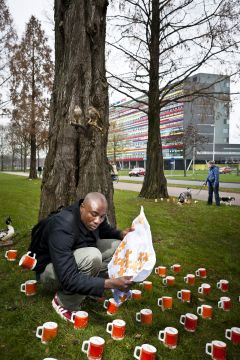
In cooperation with the University of Utrecht and together with designer Henriëtte Waal, Studio Makkink & Bey has put together a series of walks through the Uithof campus area.
The expeditions form a strategic year plan to delineate cultural components that are present in the area. Aiming at experiences, use, and visibility of special features of the Uithof, the walks progressively chart the Uithof campus into a cultural map. The first two walks have been completed and together with a website, inscribed mugs and benches, screensaver announcements on all Uithof computers, the project was launched on Friday 10th of December. The festivities were escorted by two musicians who marched alongside the first explorers of the Uithof Expeditions.
The university campus is undergoing transformations, the was oiginally planned to serve a working, or studying population, but is now slowly becoming more residential. As more functions are being added to the physical curriculum of the Uithof, the terrain as a whole remains largely undisclosed to visitors and new residents. To change this and to reveal its special characteristics, each of the walks touches on a subject relating to the area. The Uithof Expeditions lead anyone who's interested along it's artworks, secret places, architectural highlights as well as overlooked constructions, its' nature and its' history. The walks will be carefully composed in combined effort by an artist and an expert of the subject matter.
The project is announced on the sreensavers of the university computers, special mugs (available on campus) were inscribed with coordinates, outdoor benches were designed with an inlay of instructions and there's a website that is linked to a GPS system. Participants can cross-examine the terrain, add new finds and knowledge to a database both analogously and online. Anyone can participate in adding Uithof secrets, by geo-tagging and using a Flickr account. A network of knowledge is being developed integrating data of the physical landscape with knowledge available within the university faculties.
The first two walks investigate the history and culture of De Uithof. By partially restoring a disregarded Dutch water defense system from the 17th century, history was transported to present times. De Hollandse Waterlinie was traced back and made tangible in the Tank-trench Walk, a route that can be explored this spring. The other route explores the artworks that were bought over the years and can be found dispersed over the area. The art collection is chronologically unveiled, following the year of creation. The art collection that was bought with public funds that are part of a percentage agreement stating that part of the expenses should go to buying art. The last artwork was added by Studio Makkink & Bey; it is a bench the artwork coordinates inscripted in the surface.
http://www.uithofexpedities.nl/
3199 Gastgastgeber panorama's
The interior that was designed for Gastgastgeber in Oberhausen was meticulously photographed by Arie de Ruiter, who composed 360˚ degree images of his footage. By clicking on the image you can open a window to navigate through the rooms.
http://www.ariederuiter.nl
3216 Household Crates on show in Spring Projects Gallery in London
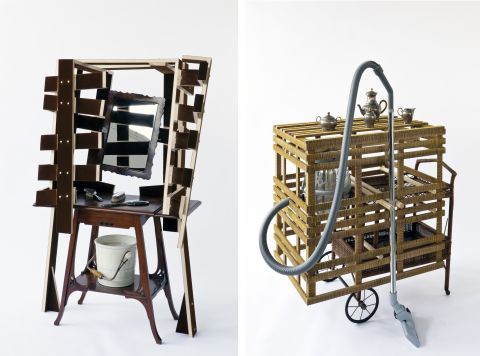
Exhibition from 5th November to 16th December: Spring Projects London.
The Crate Series: Household Crates
These shipping crates, normally used to temporarily house goods, take on a more solitary role as a sized down household unit. Each of the crates trade off space against utility. The various models encompass a specific function, concentrated inside the crate and in its material finish. In their original guise as freight packaging, the crate protects its contents, but as furniture they become a means of personal autonomy. Hiding and disguising are integral to these objects. The wooden retreats can be used to seclude a person from the outside world, but when unfolded they become furnishings inside an already furnished room. While travelling, they can form a familiar space within unknown spaces.
The Crate Series is an enquiry into the delineations in public and private time and space as well as the role of the objects we use within these spheres. Just as the function of a singular household appliance doesn't mark or dominate a room with its purpose of existence, so the bed hidden inside the BedCrate doesn't denote the room as a bedroom nor the bath and basin to a bathroom. This is a unifying theme of the series as the ClockCrate attempts to smother its own ticking sound and the VacuumCleanerCrate cleans up after serving tea from its built-in trolley.
http://www.springprojects.co.uk
Spring Projects
Spring house
10 Spring Place
London NW5 3BH
3173 Silver Sugar Spoon at Lichtenstein museum Vienna

Studio Makkink & Bey invites you and your friends to the Silver Sugar Spoon exhibition at the Liechtentein museum in Vienna.
30th of september - 15th of november, Grand Opening of the Vienna design week, Thursday, 30th september 2010.
Studio Makkink & Bey are proposing to design tableware and products in answer to the Habsburg valuables found in the Imperial Silver Collection. To start the project our designers delved into the history of sugar and silver, Imperial conduct and pastry cooking. Sugar used to be equally valuable to silver and many affluent citizens were eager to display their wealth by presenting centerpieces entirely made of sugar and by treating their guests to extravagant desserts. Studio Makkink and Bey will partner with two highly specialised companies, Sugar Bakery K.U.K. Demel and silversmith company Jarosinski & Vaugoin, both of which used to serve the Habsburg family during their reign.
The studio has been a temporary sugar laboratory to test and sketch out objects before casting them in silver. A collection of six sugar spoons are transformed into silverware. A tablecloth serves as a chronicle of the sugar history, stories being embroidered or drawn on the textile cloth. A carpet of forty-two square meters lays around the tablecloth and represents the production process of sugar in correlation to the forty-two kilos of sugar consumed per person in Austria every year. Each kilo of sugar cubes requiring one square meter in order to be produced. The centerpiece is a big vase, containing a flower arrangement made of sugar. The vase is a beautifull demonstration of the Silver making by its size, fifty centimeters high. Its shape has been drawn by the silhouette of a dessert spoon. Both vase and imagery, work together to create an optical illusion. The image on the tablecloth is deformed in such a way that the bulged reflection on the vase restores it back into original, coherent version (an optical illusion known as anamorphy). The Silver Sugar Spoon is a frozen scenery of a dessert ceremony in a sugar beet field.
3222 Solo exhibition at Helmrinderknecht gallery, Germany
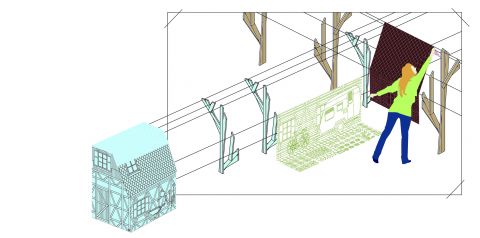
Studio Makkink & Bey invites you and your friends to the solo exhibition WashHouse
11 September - 30 October 2010 Opening reception: Friday, 10 September 2010, 6-9 pm
In Dutch design studio Makkink & Bey’s (Rianne Makkink & Jurgen Bey) world, design is a narrative based process. For their first solo exhibition at HELMRINDERKNECHT contemporary design gallery, Studio Makkink & Bey has created a site-specific walk through the three dimensional landscape of a rural village. Mohair woollen blankets hanging on a clothesline give shape to the space and divide it. Individually woven patterns and lines become a house’s exterior walls or reflect the imagery of the surrounding landscape. The washing line is draped in between simple wooden posts. Although these posts function as a laundry rack within the space, within the fictive landscape they become trees. Like houses, woollen blankets offer human beings protection and shelter. Taking care of warmth and security, they are roofs over our heads and tuck us comfortably in.
The woollen blankets were produced at the Textielmuseum’s workshop, Textilelab, in Tilburg, Netherlands. All blankets are two sided and woven with two different colours. There are a total of five patterns. Each woollen blanket is unique and exclusively available at HELMRINDERKNECHT contemporary design.
www.helmrinderknecht.com
3233 Solo exhibition at Plus Design, Italy
Studio Makkink & Bey presents Design Mattters, the first solo exhibition in Italy. Plusdesign gallery in Milan will host the exhibition.
The show will open on the 16th of September and will run till the 20th of November.
The exhibition Design Matters presents the international preview of the new working desk No Matter especially created by Studio Makkink & Bey for Plusdesign Limited Editions. The desk is made of paper mache with some details finished with wax. Also other projects of the Studio will be featured to present its creative story from the foundation to today.
www.plusdesigngallery.com
3166 Studio Makkink & Bey designs the interior of MVRDV house, Suffolk
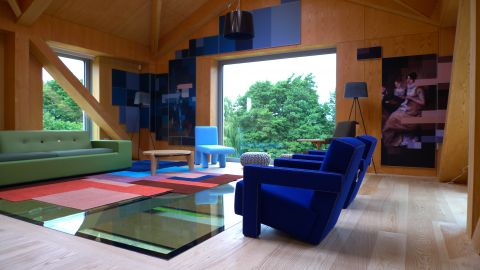
Studio Makkink & Bey at the Balancing Barn
Commissioned by Living Architecture, we were asked to create the interior of MVRDV’s Balancing Barn in Suffolk. Their design was largely inspired by the way the Barn brings the outside inside and emphasises the presence of both earth and sky.
Living Architecture aims to make modern architecture available to a wider public. While most modern architecture is either a private home or a transitory place (e.g. airports, museums, etc.), this project was set up to create public spaces with a more residential character. Writer, philosopher and creative director of Living Architecture Alain de Botton explored the notion of experiencing architecture earlier in his book: The Architecture of Happiness, this notion comes to life in the Balancing Barn, where experiences are the constituents of its interior concept and communal dwelling is in concert with with individual conduct.
The interior scheme traces the transition from earth to sky as one walks from the earthbound entrance of the Barn towards the ‘levitating’ end of the building, where the floor to ceiling window offers an uninterrupted view of the clouds and sky. Walls and floors are decorated with sampled elements of paintings by Suffolk artists John Constable and Thomas Gainsborough. The classic images gradually evolve into abstract angular colour patches, they become images reminiscent of modern art and they take on a more applied form as wall panelling. The house can accommodate two or eight people equally comfortably, feeling neither empty nor crowded, thanks to customisable furniture and fittings, mostly by Dutch designers. The clear cut Dutch furnishings and primary colours, the simple 'butt joinery' used in the construction of the designs by Studio Makkink & Bey all celebrate the elementary design idiom that is characteristic for Dutch design.
The kitchen acts as a gateway from outside to inside, following an earth theme. Upon entering you immediately notice the reproduction of a painting by Constable of a horse and carriage that seems to have just walked into the kitchen. Its colours are dispersed over the wall following it round the corner into the corridor. There are six generic sets of cutlery, crockery and glassware and two ‘special’ sets that were purchased from English companies with a long tradition of producing crockery. Thus two people can enjoy dinner using all the elements of the special tableware, whereas when there are eight visitors, each can have one piece from the special set.
The next room in the building is the gardeners room with a painting of a farm house with a tree and parts of a garden border. The fence depicted on one of the fragments and the fences in the country side surrounding the Balancing Barn modelled for the construction of the furniture that was designed by Studio Makkink & Bey. The furniture was designed to be versatile and, as well as the night stands, the beds all have one plank sticking out to clamp a reading lamp on at a preferred height. To reach the upper shelves of the built in cabinet, the night stands double as a stepladder. Both designs provide possibilities to fit the rooms to ones' need.
The following room, is the fishers room, on its wall a replica of Constable's 'The Mill Stream, Willy Lott's House' shows a mill house with a pond next to it. The water on this painting determines which colour scheme dominates the room. The corridor then moves on to the pigs room where the pigs on Gainsborough's painting give the room its pink appearance. In the adjacent cloud room the view is lifted up into the sky. Cloud fragments and grey pixel panels give the room a light tone. Sky and the notion of floating are the key elements of the living room since it hovers over the ground, suspended over the edge of the hill. Makkink & Bey have chosen Gainsborough's most famous painting of a boy dressed in blue to be the signature element of this room, the colour of his clothes echoing and reinforcing the sky theme and informing the colour scheme. Meanwhile, ladies from Constable’s “Ladies From The Family Of Mr William Mason Of Colchester” sit quietly alongside the temporary occupants of the Balancing Barn in this light-filled room.
Jurgen Bey new director of Sandberg Institute
Jurgen Bey appointed as new director of the Sandberg Institute
On September 1st 2010, Jurgen Bey became the new director of the Sandberg Institute in Amsterdam. The Sandberg Institute is part of the Gerrit Rietveld Academie and hosts its four MA programmes in the field of Fine Arts & Design. Jurgen Bey replaced Jos Houweling who has retired this July.
As director of the Sandberg Institute, Jurgen Bey aims to create links between the multidisciplinary Sandberg, the bachelor programme of the Gerrit Rietveld Academie and other institutes of knowledge and research in Amsterdam.
Together with the team of Studio Makkink & Bey, he will continue to work on design tasks and solutions in our continuously changing environment.
3213 Blown To Life in the National Glass Museum of Leerdam
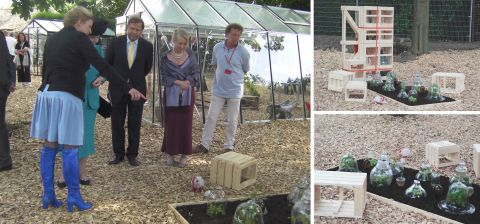
From June 23rd to September 26th 2010:
'The Bell Garden' a gardening concept for the exhibition Blown To Life in the National Glass Museum of Leerdam.
Arnout Visser and the Glass Museum in Leerdam invited Studio Makkink & Bey for a glass workshop and to do a project with this material, using existing glass objects to revive both the material and the glass workshop in Kenya.
In the workshop 'Blow To Life' in Leerdam, Kenyan glass blowers from Kitengala Hot Glass. Studio Makkink & Bey came up with a project showcasing both ancient European gardening techniques and the Kenyan glass blowing practice of using old bottles.
Starting from the 19th century, the French developed a technique called cloche farming. Cloche farming could be considered the ancestor of the glass house, where the glass protects the shoots of young plants. The bell-jar cloches can be fitted inside a garden cabinet made of crate segments you can take out to sit on and start your gardening comfortably. The plants used in the exhibition in Leerdam are vegetables and herbs oftentimes used in Kenyan recipes.
For more information, please click here.
3205 Exhibition Bloedkoralen van de Oosterschelde - Oosterschelde Coralline embankment
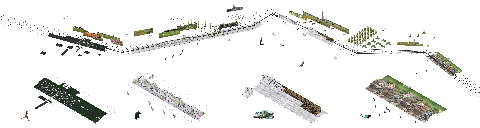
To brace the dikes of the Southern Dutch province of Zeeland, the Zeeweringen project office, the provinces' office for Water Management and other institutions involved in water management, have initiated a cultural project to re-shape the cladding of the Oosterschelde dikes.
Studio Makkink & Bey were asked to propose design strategies to harness and fortify the dikes, marrying functionality with a refined exterior into an elegant trimming. We came up with four different ways to strengthen the dikes and add a cultural purpose to the embankment at the same time. Each proposal opens the dikes up for the general public to solicit an automatic maintenance of the dike, a process that is assisted by local clubs who are involved to help guard and take care of the area.
Our studio is suggesting mobile shower units and eateries for sport fans and bird watchers, who can revive themselves after a days' out by the sea. Their club is responsible for the quality of the refreshment booths and provision of fresh, local food. Traditional jewelry is pressed into the asphalt in a pattern and a sports field grid is painted in white lines on the asphalt, further down the dike.
The second proposal is a concrete landscape for nature enthusiasts, who can peek through tunnels and walk between concrete trees rising up from the bottom of the sea when the tide has withdrawn. The same trees form a sea forrest for divers during the tide is high.
Thirdly, concrete caissons and their molds provide a possible bungalow park when fitted to this end. The bungalow park grows according to demand and the mound is likely to pile up quicker than the rising of the sea level, thus automaticly sustaining the dike.
Lastly, we've proposed to clad the dike with a layer of Elastocoast with zones of different structures, textures and patterns. Mimicking nature, this ornate cladding makes up a manufactured accretion on top of the dike and in the water.
3199 GastGastgeber - RUHR 2010
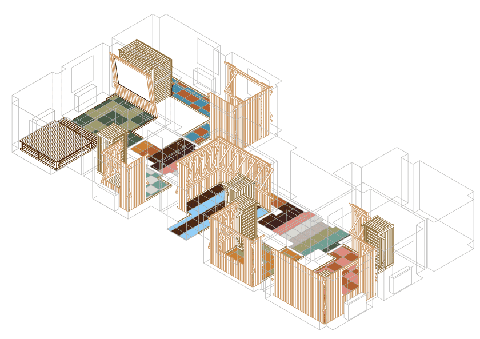
For RUHR.2010, European Capital of Culture, Studio Makkink & Bey was asked by Bureau Venhuizen to design guestrooms and to act as a curator in the GastGastgeber project. The event opened on Saturday the 1st of May in the water tower of Oberhausen Central Station.
Studio Makkink & Bey has designed the interior of eight rooms of the temporary hotel in the former water tower. The interiors of these rooms have been furnished with a wooden construction and a flip-up bed, to give the rooms a double function of private bedroom as well as a public workroom. An artist will be chosen for each room to permanently exhibit their work, a guest artist will then be invited to respond by making a new piece during his/her stay at the hotel.
The RUHR area was the European Capital of Culture in 2010. The GastGastgeber project, a joint effort of Dutch and German cultural institutions, is planning a number of interventions on several locations. The Dutch are guests in the Ruhr area, but will also act as hosts - hence the name Gast(guest)Gastgeber(host).
Address:
Wasserturm Oberhausen (via main hall)
Willy-Brandt-Platz 1
46045 Oberhausen
For more information go to:
http://nlinruhr.bureauvenhuizen.com/
http://www.nl-ruhr.de/
3204 Exhibition by Studio Makkink & Bey for Nissan in the Lloyd Hotel
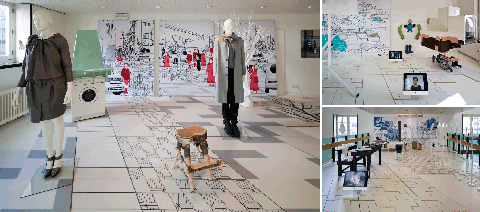
Februari 10th until Sunday the 14th: our exhibition for the launch of the Nissan cube in the Lloyd Hotel in Amsterdam.
The context of the Nissan Cube, future car culture, and refined public spaces is presented in three scenarios. On three platforms in the hotel, each displaying one scenario, visitors can peek into our view on refining the public realm. We've chosen to show works which signify new and past culture, revealing the story in between about the way products and culture evolve through reciprocal response.
Lloyd Hotel & Cultural Embassy Oostelijke Handelskade 34 Amsterdam
3193 Happy Families exhibition at Kunsthal Kade
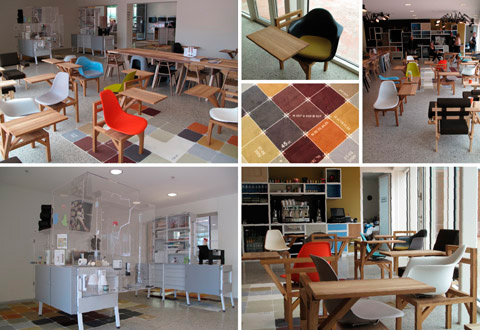
The Happy Families exhibition shows the entire story of Studio Makkink & Bey and our design philosophy, which is largely based on personal relationships, connections with like-minded people and collaborative arrangements. It is more than simply a display of finished work, but shows how the Studio’s design practice has developed over time.
28 November 2009 - 14 February 2010 in Kunsthal KAdE in Amersfoort, the Netherlands
Studio Makkink & Bey Prooff Lab - exhibition at Boijmans van Beuningen Rotterdam and Rotterdam Design Prize 2009
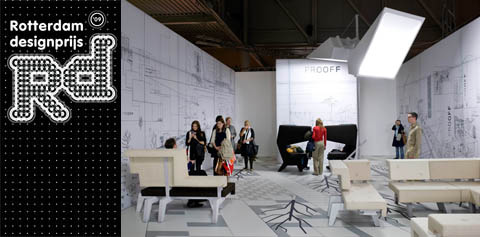
Studio Makkink & Bey studied the subjects mobility in combination with work for PROOFF LAB, a platform for the development of new workscapes, in collaboration with SV, manufacturers of office furniture. This resulted not only in new furniture concepts, but also in a vision of versatile work environments: a ‘progressive office’. Here, the work environment becomes a meeting place for the exchange of ideas and experiences, rather than just serving profit motifs. We expanded the work environment to form a campus, a knowledge environment composed of communal indoor and outdoor spaces where working and living become one. Working our way between the scales of product design and architecture, we asked ourselves ‘What if a piece of furniture were itself a space?’. The same question that gave rise to the Ear Chair, a seat wide enough and high enough to prevent distraction by shielding the user from outside sights and sounds. The result is an individual space within the public area. Other products are the Work Lamp and the Work Sofa, which allows different physical working positions, whether lounging, leaning or sitting. The Work Lamp emits bright white light and has the look of a hybrid between a functional workshop lamp and a piece of street lighting. Our thinking about work and mobility began, not with the car, but with a piece of furniture: the office chair. The result is the Slow Car that was intended as an alternative to office seating rather than motor vehicles.
Our hat goes off to Joost Grootens who's won the 2009 Rotterdam Design Prize with his clear-cut design of four atlases.